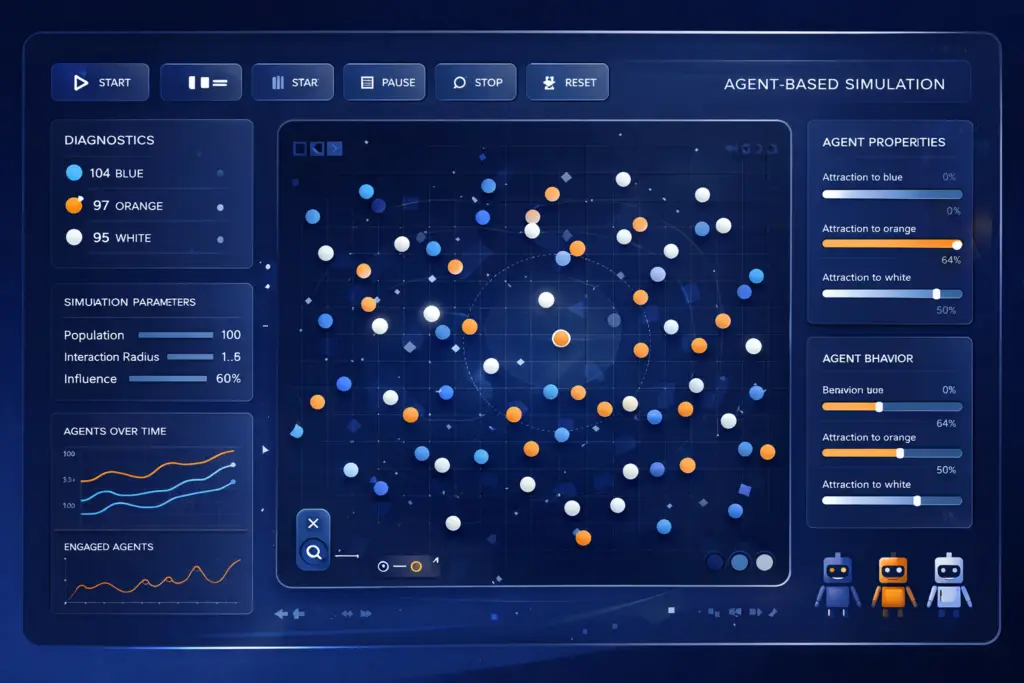
What are Agent-Based Models?
Agent-based models (ABMs) are a way to simulate how complicated systems behave by modeling the individual people or things inside them and seeing what happens when they interact.
Instead of using big formulas that only show the average result, ABMs simulate many small actors and let the big picture patterns emerge naturally.
What is an “agent”?
In an ABM, an “agent” is a simple character in the simulation. It could be a:
- person
- customer
- vehicle
- animal
- company
Each agent follows a few simple rules like: “If I see my friend share this, I might share too.”
How it works (big picture)
ABMs don’t control the whole system from the top. They focus on local behavior: each agent reacts to what’s around them. When you simulate many agents at once, you can see system-level outcomes like growth, congestion, or crowd behavior.
Think of a stadium crowd: nobody tells the whole crowd what to do, but waves can still appear because people copy nearby people.
Why this matters
Real life isn’t “average.” People differ, and they change behavior depending on context. ABMs can capture that because:
- agents can be different (not one “average person”)
- they make decisions based on local information
- big patterns come from many small interactions
Simple example: social media sharing
Imagine you want to understand how a post spreads online. An ABM can:
- represent each user as an agent
- give each agent simple share rules
- simulate how the post travels through a network
When you should use ABMs
ABMs are useful when:
- individual behavior matters
- interactions between people/things matter
- averages hide important risks or patterns
Common areas: marketing growth loops, customer adoption, traffic, organizations, public policy, ecology, and education.
Limits (the honest part)
- ABMs don’t predict the future perfectly
- they need careful assumptions and validation
- they can take more time to build than simple models
Summary
Agent-based models simulate many individuals acting locally. You don’t get one “magic answer” — you get better insight into how outcomes can happen and what trade-offs you’re making.