Simulation & Decision Support
Agent-Based Modeling for Simulation: What It Is, Why It Works, and When to Use It
Agent-based models (ABMs) simulate complex systems by modeling individual actors (“agents”) and their interactions. This post explains how ABM simulations work, what they’re best for, real-world use cases, and how to turn an ABM into an interactive, playable decision tool.
What is an agent-based model?
An agent-based model (ABM) is a simulation approach that represents a system as a collection of autonomous agents—people, customers, firms, vehicles, animals, bots—each following simple rules. The system’s “big picture” behavior emerges from many local interactions, not from one top-down equation.
In an ABM, agents can differ in attributes (budget, preferences, risk tolerance), behaviors (copy, learn, adapt), and relationships (networks, geography, group membership). This makes ABMs especially useful when averages hide important dynamics.
Why agent-based simulation is powerful
Traditional models often ask: “What happens on average?” ABMs ask: “What happens when different kinds of individuals interact under changing conditions?”
Key strengths of ABM simulations
- Heterogeneity: agents can be different instead of “one average person.”
- Non-linear effects: small changes can trigger big outcomes (tipping points).
- Feedback loops: outcomes influence future behavior (reinforcement, saturation, collapse).
- Path dependence: history matters; order of events can change results.
- Emergence: macro patterns appear without being explicitly programmed.
If your system involves people, incentives, networks, congestion, competition, or contagion, ABM is usually one of the best tools available.
Use cases across business, policy, and science
Business & marketing
- Referral and viral loops: how sharing, incentives, and friction drive growth.
- Customer adoption: diffusion in networks, social proof, word-of-mouth effects.
- Churn and retention: cohorts, habits, switching costs, competitor offers.
- Pricing dynamics: willingness-to-pay distributions and competitive response.
Public sector & policy
- Mobility & traffic: routing decisions, congestion, infrastructure scenarios.
- Health interventions: contact patterns, targeted policies, system capacity stress.
- Housing markets: affordability, migration, development constraints.
Science, education, and research
- Ecology: population dynamics, resource competition, spatial effects.
- Social systems: segregation, cooperation, polarization, norm formation.
- Learning tools: “playable” simulations that teach complex systems fast.
When to choose ABM vs other approaches
ABMs are not always the right answer. Use an agent-based approach when individual behavior and interaction shape outcomes. Use simpler models when the system is stable, linear, and well-approximated by aggregates.
Rule of thumb: If your result depends on who meets whom, when, and under what incentives, you’re in ABM territory.
ABM is a good fit if:
- agents differ (segments, roles, resources)
- networks matter (friends, referrals, supply chains)
- behavior adapts (learning, imitation, policy response)
- feedback loops exist (growth, congestion, trust)
- you need “what-if” scenario exploration
How an ABM simulation is built
- Define the question: what decision will this simulation support?
- Specify agents: types, attributes, goals, and constraints.
- Define environment: space, network, market rules, capacity limits.
- Rules & interactions: how agents decide and influence each other.
- Calibration: align parameters with data and domain knowledge.
- Validation: check whether the model reproduces known patterns.
- Experiments: run scenarios and sensitivity tests.
- Insights: interpret results (not as prophecy, as decision support).
Making ABMs interactive and “playable”
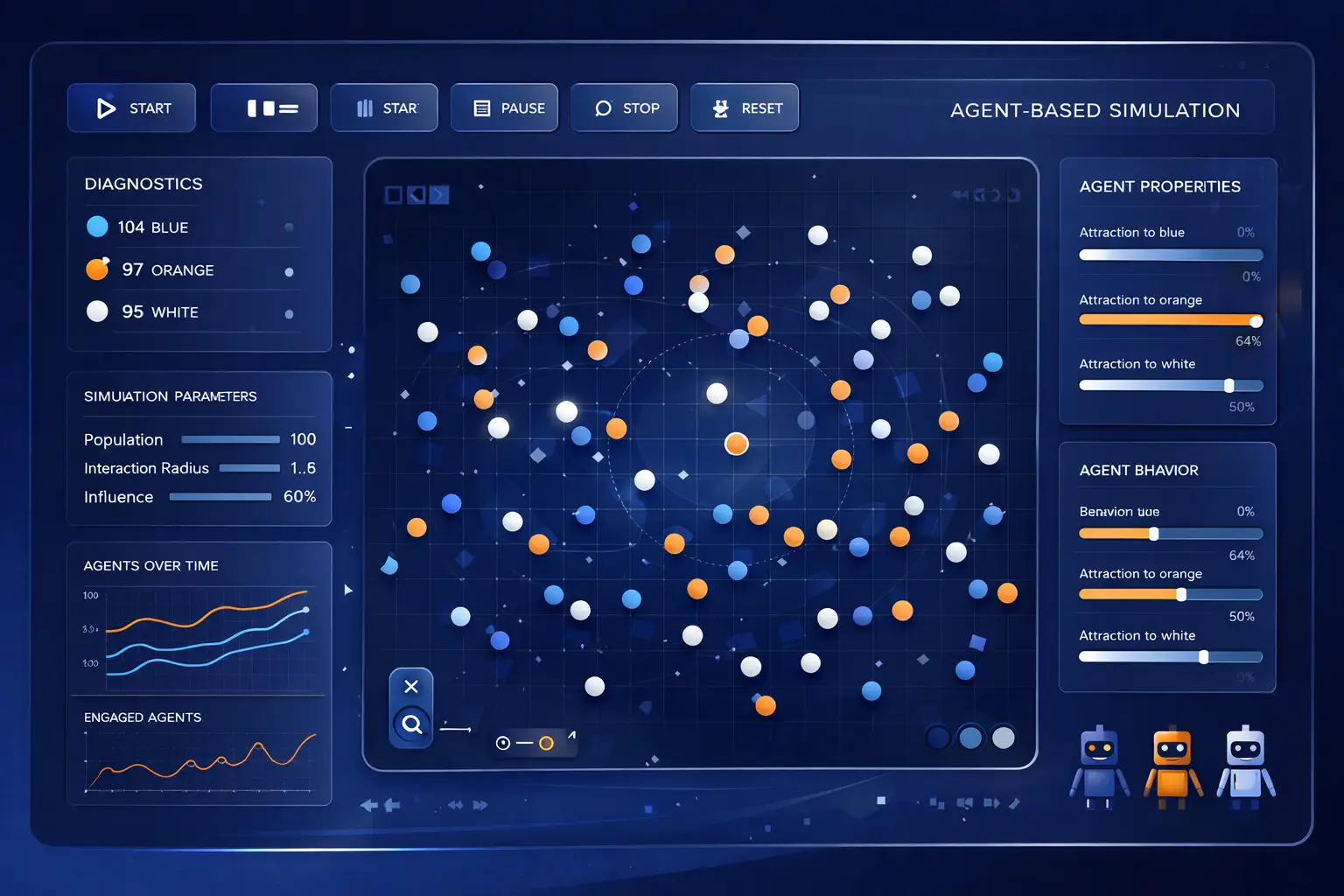
A major upgrade is turning an ABM into an interactive tool. Instead of sending a report, you ship a simulation where stakeholders can change parameters, run scenarios, and see outcomes in real time.
What “playable” ABMs enable
- Scenario planning: compare interventions and trade-offs quickly.
- Explainability: show causal mechanisms, not just charts.
- Alignment: teams build shared understanding faster.
- Decision support: explore risk and uncertainty without false certainty.
This is especially valuable for marketing growth loops, platform dynamics, operations, and policy where intuition is often wrong—and expensive.
Common mistakes (and how to avoid them)
- Over-claiming: ABMs explore possibilities; they don’t “predict the future.”
- Overfitting rules: too many micro-rules can hide the true drivers.
- No validation: if it can’t match known patterns, don’t trust scenarios.
- Ignoring sensitivity: results that change wildly with small tweaks need caution.
- Bad communication: a simulation without interpretation becomes a toy.
FAQ
Are agent-based models the same as AI?
No. ABM is a simulation method. You can add machine learning components, but ABMs often use simple decision rules to study system behavior and emergent outcomes.
Do ABMs require a lot of data?
Not always. ABMs can start from theory and domain knowledge, then improve with data for calibration and validation. The key is transparency about assumptions.
What tools are used to build ABMs?
Popular options include NetLogo (fast prototyping), Mesa (Python), Repast, and custom stacks for browser-based interactive simulations.