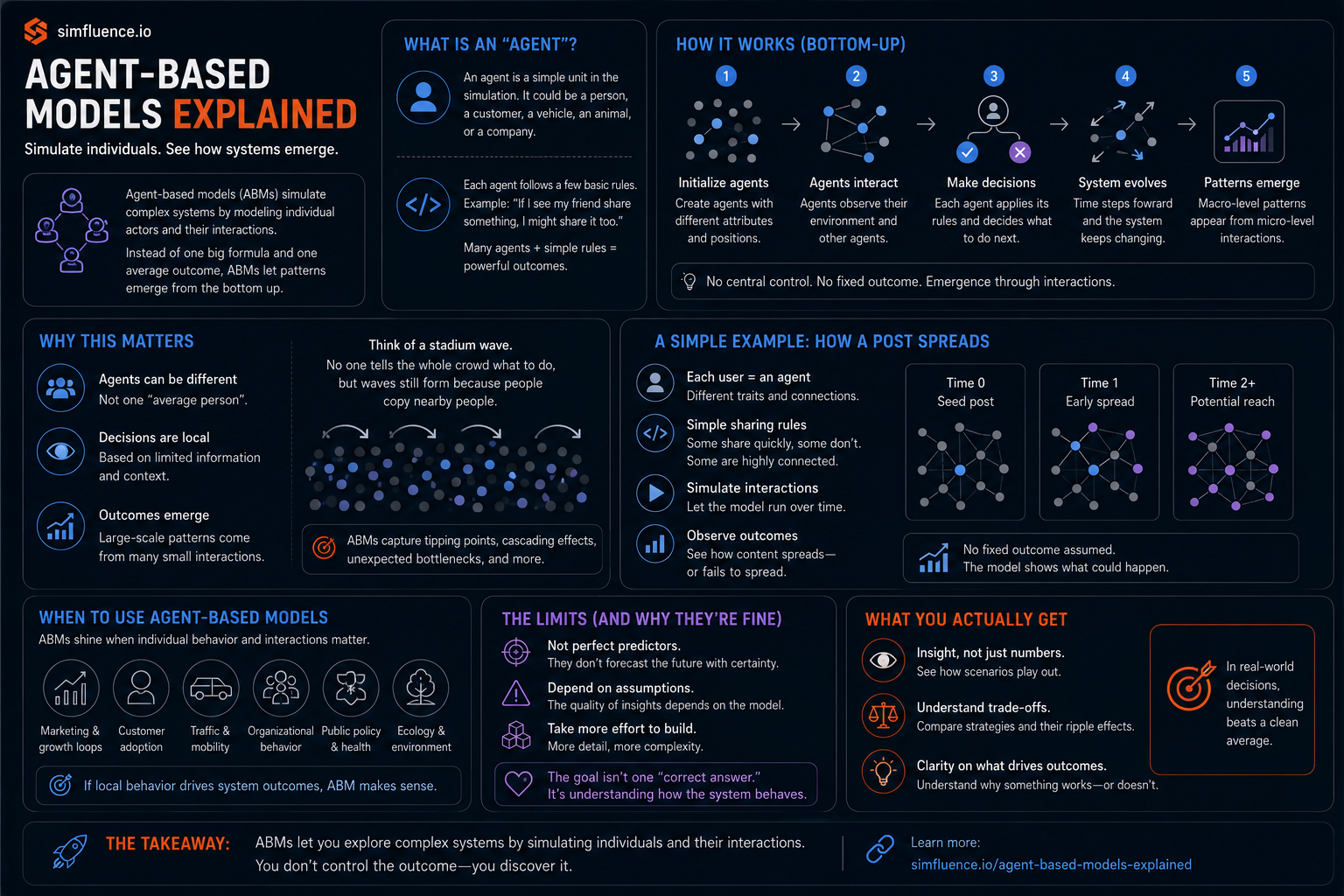
Agent-based models (ABMs) are a way to simulate how complex systems behave by focusing on the individual people or things inside them and seeing what happens when they interact.
Instead of using big formulas that give you one average result, ABMs take a different approach. They simulate many small actors and let patterns emerge naturally from their behavior. You don’t tell the system what the outcome should be—you define how parts behave, and the outcome forms on its own.
What is an “agent”?
In an agent-based model, an agent is a simple unit in the simulation. It could be a person, a customer, a vehicle, an animal, or even a company.
Each agent follows a few basic rules. For example: “If I see my friend share something, I might share it too.” These rules don’t have to be complex. What matters is how many agents follow them and how they influence each other.
How it works in practice
ABMs don’t control the system from the top. They work from the bottom up.
Each agent reacts to what’s happening around them—other agents, their environment, or changes in conditions. When you simulate many of these interactions at once, system-level patterns start to appear.
A simple way to think about it is a stadium crowd. No one tells the entire crowd what to do, but waves still form because people copy nearby people. The pattern emerges from local behavior.
Why this matters
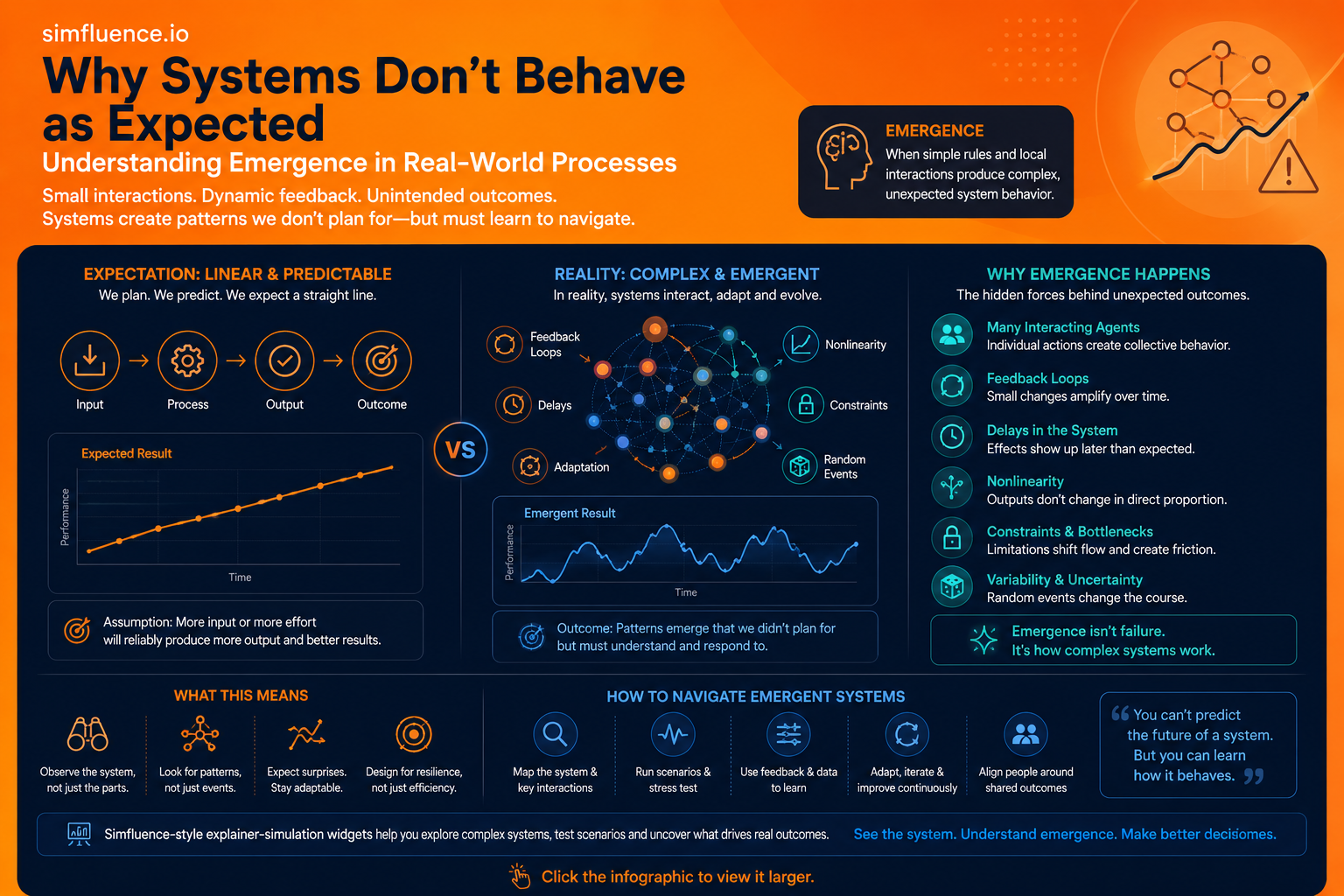
Real life isn’t average.
People behave differently. They react to context. They influence each other. And those interactions often drive outcomes more than any single variable.
ABMs are useful because they capture that:
- agents can be different instead of one “average person”
- decisions are based on local information
- large-scale outcomes come from many small interactions
This makes it possible to see things that traditional models often miss—like tipping points, cascading effects, or unexpected bottlenecks.
A simple example
Imagine you want to understand how a post spreads on social media.
With an ABM, you can represent each user as an agent, give them simple sharing rules, and simulate how the content moves through a network. Some people share quickly, others don’t. Some are highly connected, others are not.
From that, you can observe how something spreads—or fails to spread—without assuming a fixed outcome upfront.
When to use agent-based models
ABMs are most useful when individual behavior and interactions actually matter.
If the outcome depends on how people influence each other, how decisions change over time, or how local behavior builds into system-wide effects, then an agent-based approach makes sense.
That’s why they’re used in areas like marketing growth loops, customer adoption, traffic systems, organizational behavior, public policy, and ecology.
The limits (and why they’re fine)
Agent-based models aren’t perfect.
They don’t predict the future with certainty. They depend on assumptions. And they can take more effort to build than simpler models.
But that’s not really the point.
The goal isn’t to get one “correct answer.” It’s to understand how a system behaves, what drives outcomes, and where things can break.
What you actually get
With an ABM, you don’t get a single number.
You get insight.
You see how different scenarios play out. You understand trade-offs. You start to see why something works—or doesn’t.
And in most real-world decisions, that’s far more useful than a clean average.