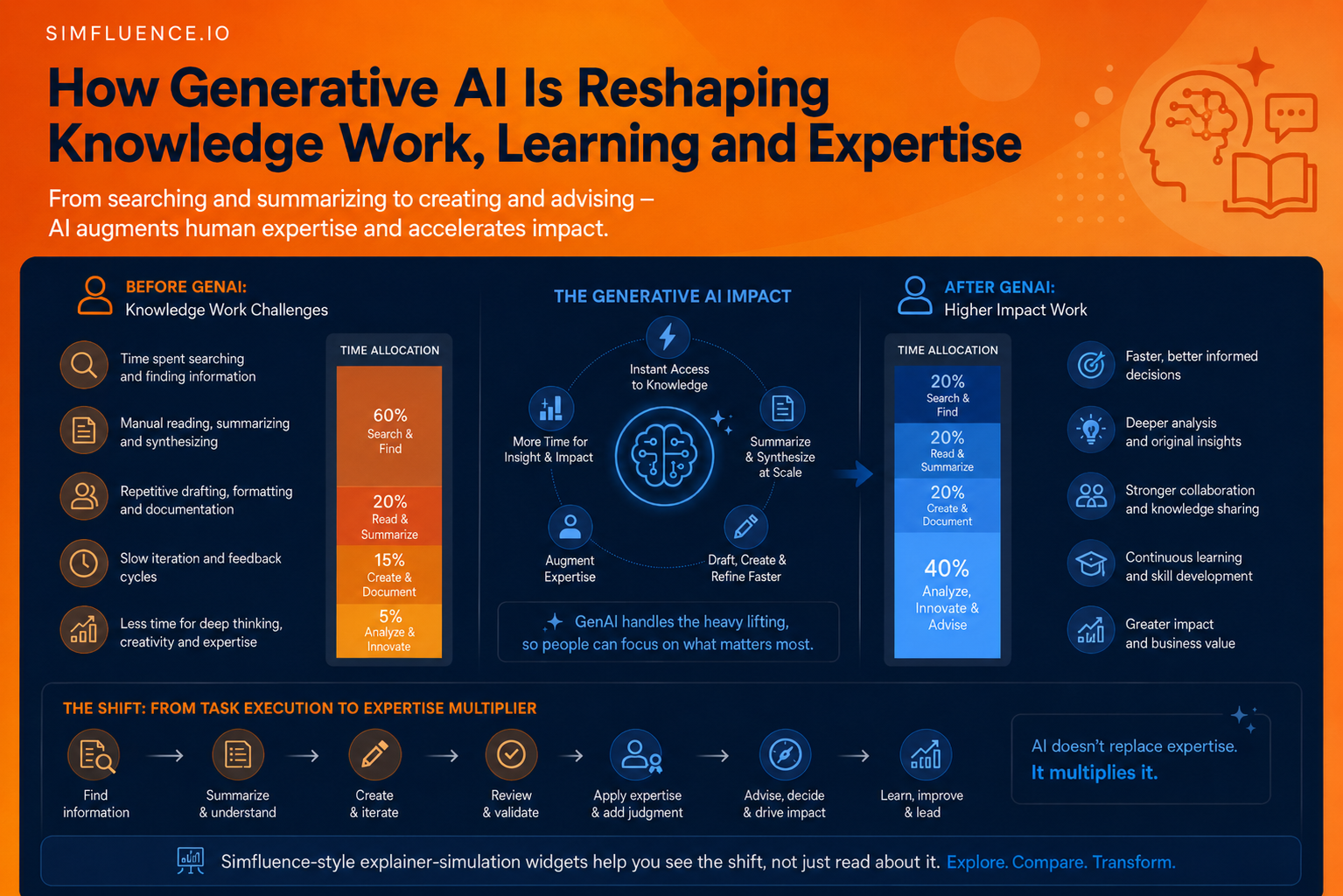
Generative AI is often discussed as a productivity tool. It writes faster. It summarizes faster. It helps people code, plan, translate, analyze, explain, and generate ideas faster. That is true, but it is also too narrow.
The larger change is not only that AI helps people complete tasks more efficiently. The deeper shift is that generative AI changes how knowledge moves through society. It changes who can access expert-like support, how quickly they can use it, how much they depend on institutions, and where responsibility for judgment begins to move.
This is why generative AI is not just a software trend. It is a social process. And social processes are hard to understand from static text alone. That is exactly where simulation widgets and interactive explainers become useful.
From knowledge society to mass knowledge society
Modern societies have often been described as knowledge societies. In a knowledge society, information, expertise, education, analysis, and professional competence become central resources. Value is created not only through physical production, but through the ability to process information, interpret complexity, and apply specialized knowledge.
But the classic knowledge society was still uneven. Expertise was concentrated in institutions: universities, schools, consulting firms, public agencies, professional organizations, research centers, and specialist networks. If you needed legal interpretation, technical advice, a good explanation, medical clarification, coding help, or strategic analysis, you usually needed some combination of time, money, education, location, social access, or confidence.
Generative AI weakens some of those barriers. A person can now ask for an explanation, draft, comparison, translation, code example, learning path, argument map, or first-level interpretation in seconds. The result may be incomplete. It may be wrong. It may require checking. But the basic access pattern has changed.
Knowledge is no longer only something people search for, study, and receive through institutions. It is increasingly something they request directly.That shift points toward what can be called a mass knowledge society: a society where many first-level knowledge functions become available to ordinary users through AI systems. Not because everyone becomes an expert. But because expert-like assistance becomes more widely accessible.
Why this needs a simulation
The transition to a mass knowledge society is not automatic. It depends on several conditions that interact with each other. AI may become more accessible, but people may not become more skilled at using it. Institutions may encourage AI adoption, but not build strong validation habits. Local models may improve, but platform concentration may still increase. Work may become faster, but also more pressured. More people may gain access to knowledge, but pseudo-expert risk may rise at the same time.
This is the problem with many AI debates: they describe one variable at a time.
- “AI improves productivity.”
- “AI creates misinformation.”
- “AI democratizes knowledge.”
- “AI concentrates power.”
- “AI helps small countries.”
- “AI weakens expertise.”
All of these can be partly true at the same time. The real question is how these forces combine. That is why the Simfluence explainer widget uses a transformation meter instead of a fixed argument. It lets users change the assumptions and see how the social picture shifts.
The Transformation Meter
The widget Generative AI and the Rise of the Mass Knowledge Society is built around one central question: How far has society moved from a traditional knowledge society toward a mass knowledge society?
The transformation meter gives a simple reading from Knowledge Society to Mass Knowledge Society. A low score suggests that expert institutions still carry most of the trust, responsibility, and knowledge access. A high score suggests that AI systems have pushed more knowledge functions toward ordinary users, organizations, students, workers, and citizens.
But the score is not the main point. The main point is that the user can see what pushes the system. The model includes six assumption levers:
- AI accessibility
How cheap, available, and easy AI tools are for ordinary users. - AI literacy
How well people understand AI limits, ask better questions, and know when to double-check. - Validation discipline
How strongly users, schools, workplaces, and institutions check AI answers before acting on them. - Platform concentration
How much access, infrastructure, and rules are controlled by a few large companies. - Work pace pressure
How much schools, workplaces, and services expect faster output simply because AI exists. - Local model maturity
How capable local, in-house, open, or community-based AI systems become compared with dependence on global platforms.
These levers make the issue visible. They show that the future of AI is not driven by access alone. A society with high AI accessibility but low AI literacy may not become more knowledgeable. It may simply become more confident, faster, and more error-prone.
A society with strong validation habits may benefit more from AI than one that treats every generated answer as usable. A society with mature local models may reduce dependence on global platforms. A society with high work pace pressure may turn AI productivity into another form of acceleration and stress.
The widget turns an abstract debate into a system people can inspect.
The upside: knowledge reaches more people
The positive scenario is real. Generative AI can widen access to explanations, drafts, learning support, practical guidance, and technical help. This matters for students, workers, small businesses, public sector employees, rural communities, and smaller countries.
A person no longer has to wait for every first-level answer. A small organization can test ideas before hiring expensive external help. A student can ask follow-up questions without shame. A public servant can summarize complex material faster. A founder can prototype a message, model, or workflow without a full team.
This is where the mass knowledge society becomes powerful. It lowers the starting cost of thinking, learning, writing, building, and asking. In Simfluence terms, this is exactly the kind of shift that benefits from being shown rather than only explained. The value is not just in saying “AI increases access.” The value is in showing how access interacts with literacy, validation, dependency, and institutional adaptation.
The trade-off: judgment moves to users
The same access also creates a problem. When AI gives people expert-like output, it can also move judgment onto people who may not know how to judge the output.
A user may receive a confident explanation without understanding whether it is accurate. A worker may produce a good-looking draft without knowing whether the reasoning is weak. A student may get a clear answer without learning how to verify it. A manager may see AI as a way to cut expert review too early.
This creates pseudo-expert risk. People may sound knowledgeable before they really understand the topic. That does not mean AI should be avoided. It means AI use needs guardrails: checking habits, source criticism, domain expertise, institutional responsibility, and better AI literacy. In the widget, this becomes visible. If AI access rises but AI literacy stays low, the model does not simply move toward a better knowledge society. It also raises the risk side of the map.
That is the point of an explainer simulation: it can show both the upside and the trade-off at the same time.
Why static explanations are not enough
A static article can describe the idea. An interactive explainer lets people test it. That difference matters, especially for topics like AI, society, and institutional change. These topics are not linear. They are full of feedback loops, thresholds, trade-offs, and unintended consequences.
For example:
- More AI access can increase knowledge access.
- But more access can also increase pseudo-expert risk.
- Better AI literacy can reduce that risk.
- But higher work pace pressure can weaken careful validation.
- Lower platform concentration can reduce dependency.
- But weaker platforms may also mean weaker quality, weaker safety systems, or more fragmented standards.
These are not simple “good” or “bad” effects. They are system effects. This is why Simfluence focuses on interactive simulations and explainers. They help turn complex arguments into something people can see, adjust, and discuss. Instead of asking users to accept a claim, the model lets them test the logic behind it.
Why this matters for Simfluence
It is about making complex change understandable. Generative AI affects education, work, public services, expertise, trust, platform power, and social acceleration. These effects do not happen separately. They interact. That makes the topic difficult to explain with a normal chart or paragraph. A simulation can show the structure behind the argument:
- What changes when access increases?
- What happens if literacy stays low?
- What if validation improves?
- What if platform concentration rises?
- What if local models mature?
- What if work pressure increases faster than institutions can adapt?
These are not only academic questions. They are useful for teaching, strategy, public communication, product positioning, and policy discussion.
The widget can be used as an AI society teaching tool because it gives people a shared object to think with. Instead of debating AI in vague terms, users can adjust assumptions and see the possible social shape that follows.
The bigger point
Generative AI is often presented as a tool that helps individuals work faster. But the more important question is what happens when millions of people gain access to expert-like support at the same time. That is the real transformation.
- Knowledge becomes more immediate. Expertise becomes partially redistributed. Institutions lose some monopoly over first-level explanation. Users gain more capability, but also more responsibility.
- Work speeds up.
- Validation becomes more important.
- Platform power becomes harder to ignore.
This is why the rise of generative AI should be understood as part of a broader shift from knowledge society to mass knowledge society. The question is not only whether AI can generate better answers. The question is whether society can build the literacy, institutions, safeguards, and habits needed to use those answers well. That is exactly the kind of question an interactive explainer can make visible.