Most websites lose visitors fast. People land, skim a few lines, and leave. Not necessarily because the content is bad, but because nothing pulls them in or gives them a reason to stay.
That’s where the difference between passive content and interactive content starts to matter.
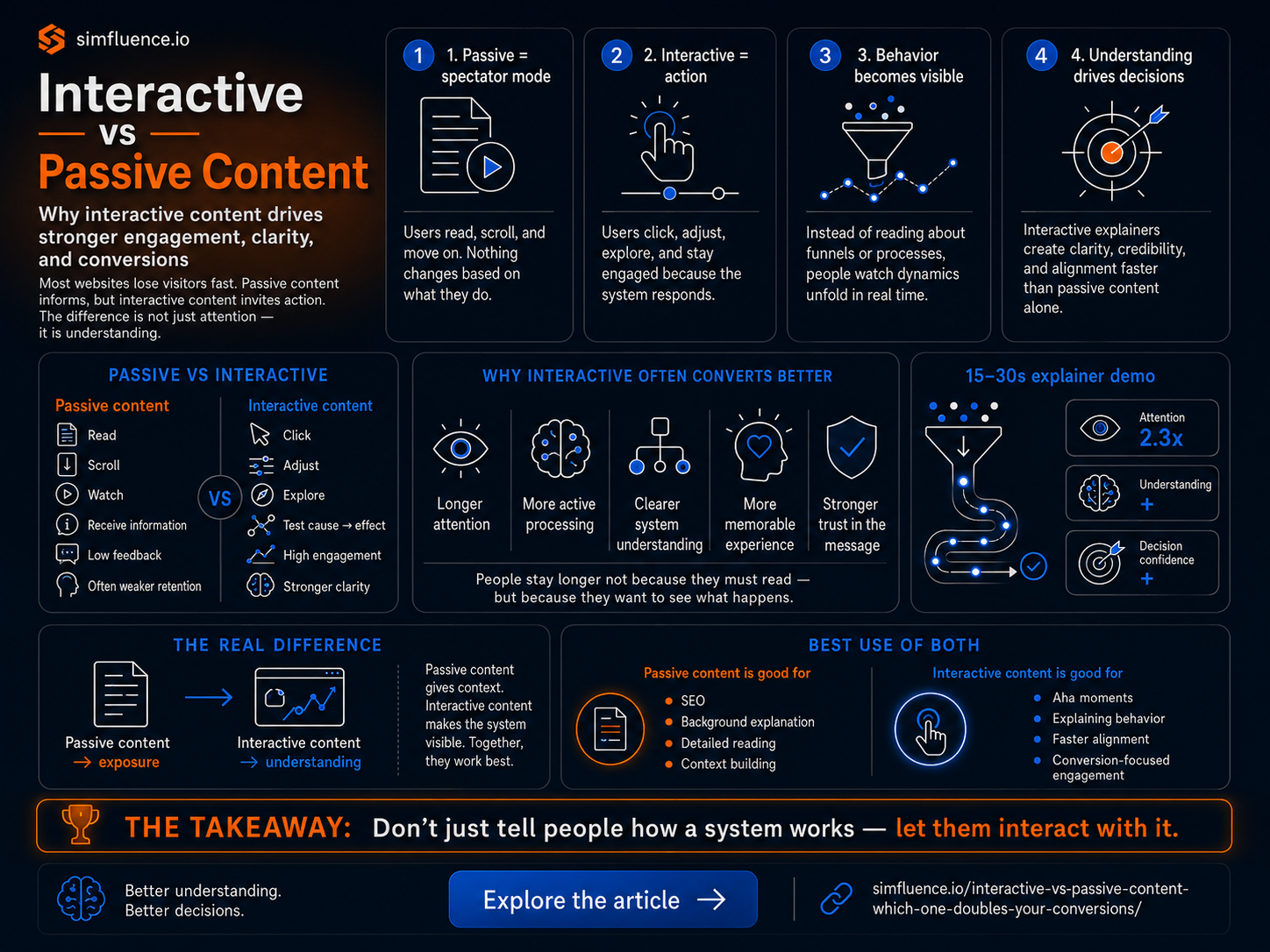
Passive content is what most companies rely on—blog posts, articles, videos, infographics. It can deliver information well, but the user remains a spectator. They read, scroll, and move on. Nothing changes based on what they do.
And that’s the limitation. If users don’t interact, they don’t engage. And if they don’t engage, they don’t stay long enough to actually understand anything.
Interactive content works differently. It doesn’t just present information—it invites action. The user clicks, adjusts, explores. Even something simple like a calculator changes the experience, but the bigger shift happens with interactive simulations, where behavior unfolds in real time.
At that point, it’s no longer just content. It’s a system you can interact with.
And that changes attention. People don’t stay because they’re forced to read. They stay because they’re trying to figure out what’s happening.
That’s the real difference: exposure vs understanding.
Most passive content exposes you to information. It tells you how something works, but the actual dynamics remain abstract. You can read about funnels, processes, or user behavior all day, but you don’t really see them.
With interactive simulations, you do. You see users move through a funnel, where they drop off, how small changes ripple through the system. You don’t interpret a chart—you watch behavior unfold.
This also shifts how people perceive credibility. When something is shown as a working system, it becomes easier to question, explore, and align around. People stop debating interpretations and start reacting to what they see.
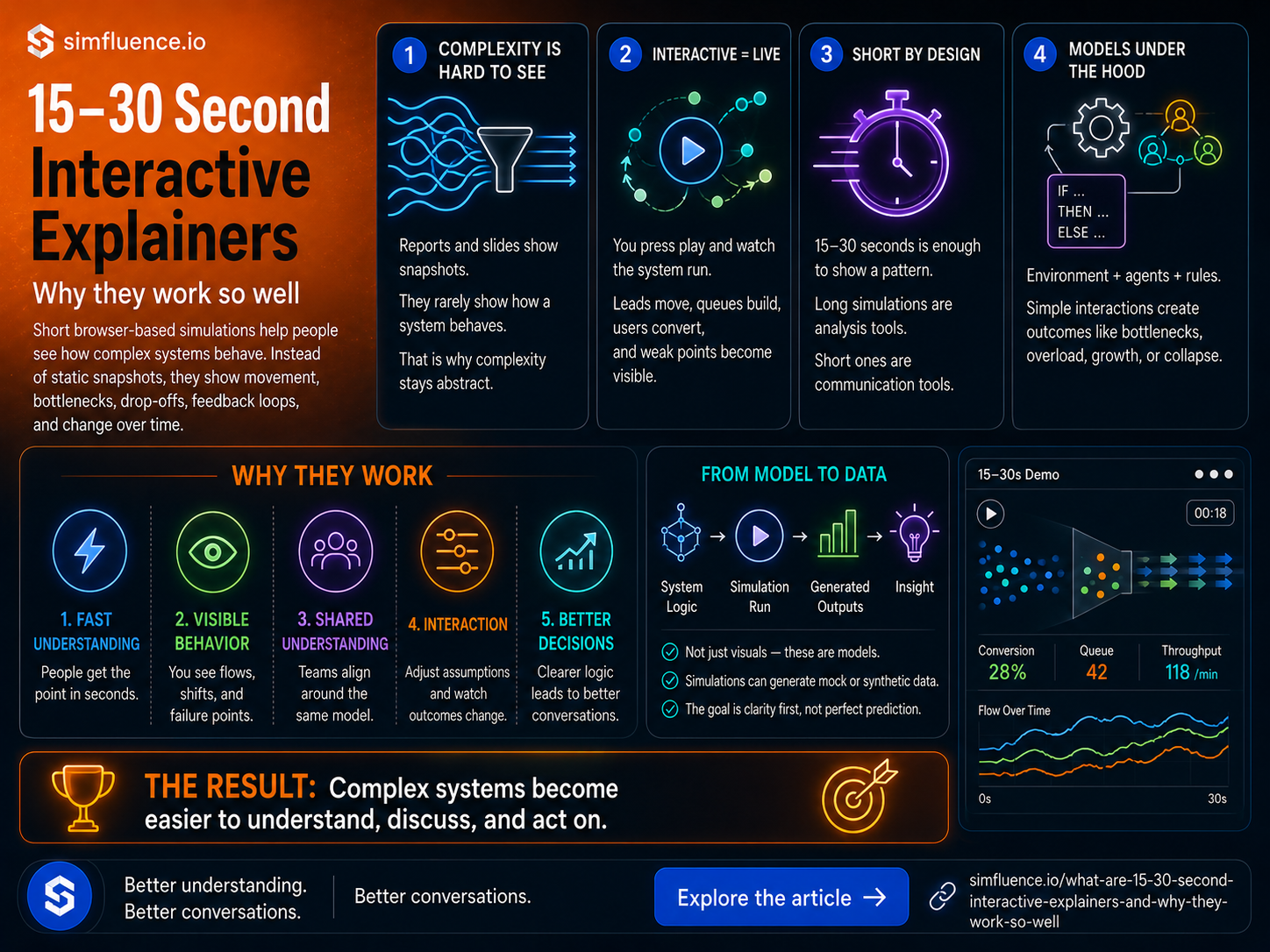
At Simfluence, this is exactly the focus. Not long, complex tools, but 15–30 second interactive explainers — small, focused simulations that highlight one key dynamic clearly. Just enough to trigger an “aha” moment without overwhelming the user.
These simulations aren’t built to explain everything. They’re built to make one thing obvious—how a system actually behaves.
Under the hood, they don’t necessarily rely on real datasets. They are built as systems with defined rules, agents, and interactions. When they run, they generate outputs. If the logic is simple, the result is closer to mock behavior. If the logic reflects real-world dynamics, the output becomes synthetic data—generated, but meaningful.
The goal isn’t to replay reality. It’s to make the system understandable.
That doesn’t make passive content useless. It still plays a role in SEO, deeper explanations, and building context. But on its own, it rarely creates clarity or alignment.
The real impact comes from combining both. Passive content gives context. Interactive content creates clarity.
In the end, it comes down to a simple question. Do you want people to read your content, or actually understand it?
Because understanding is what drives decisions. And decisions are what move things forward.