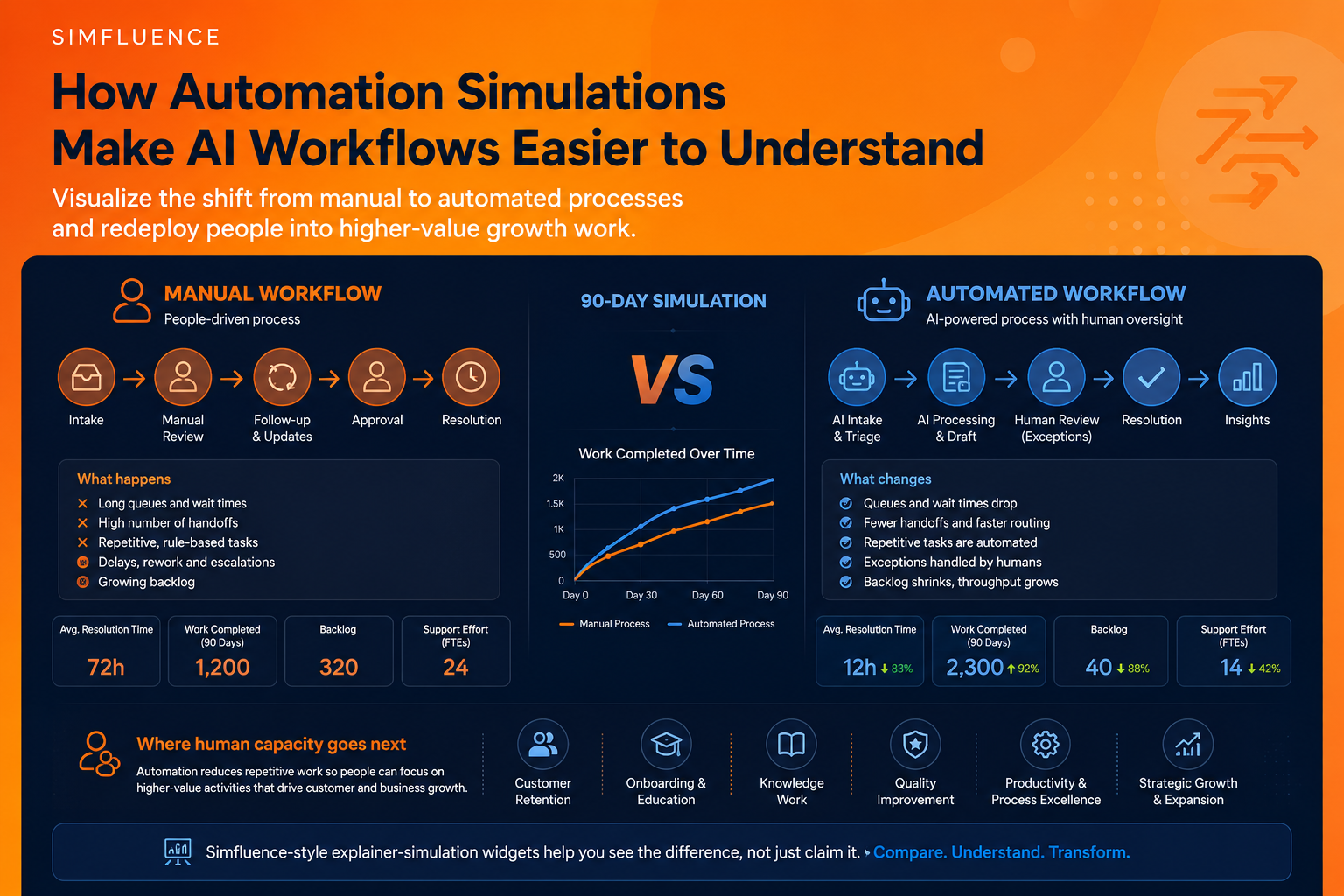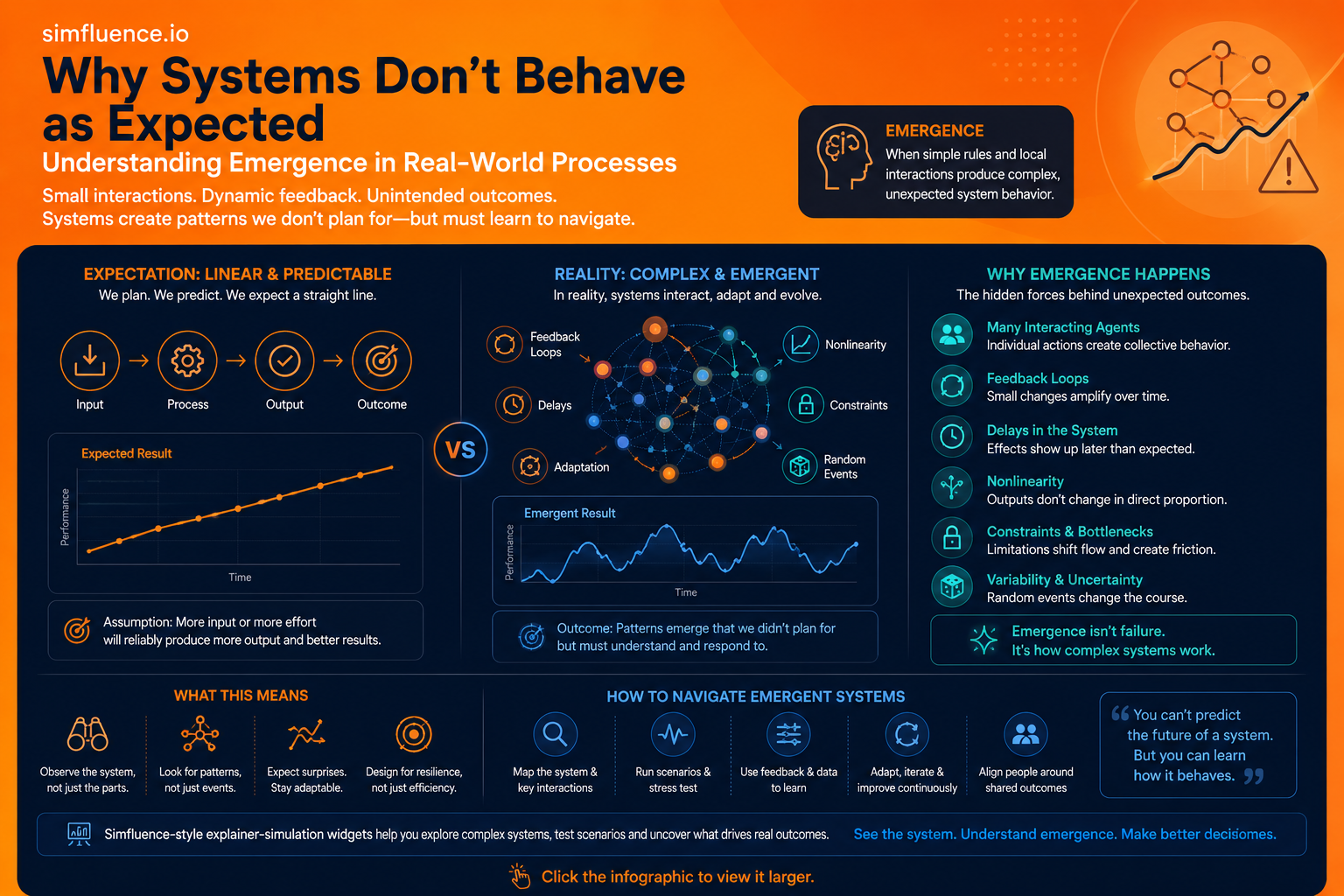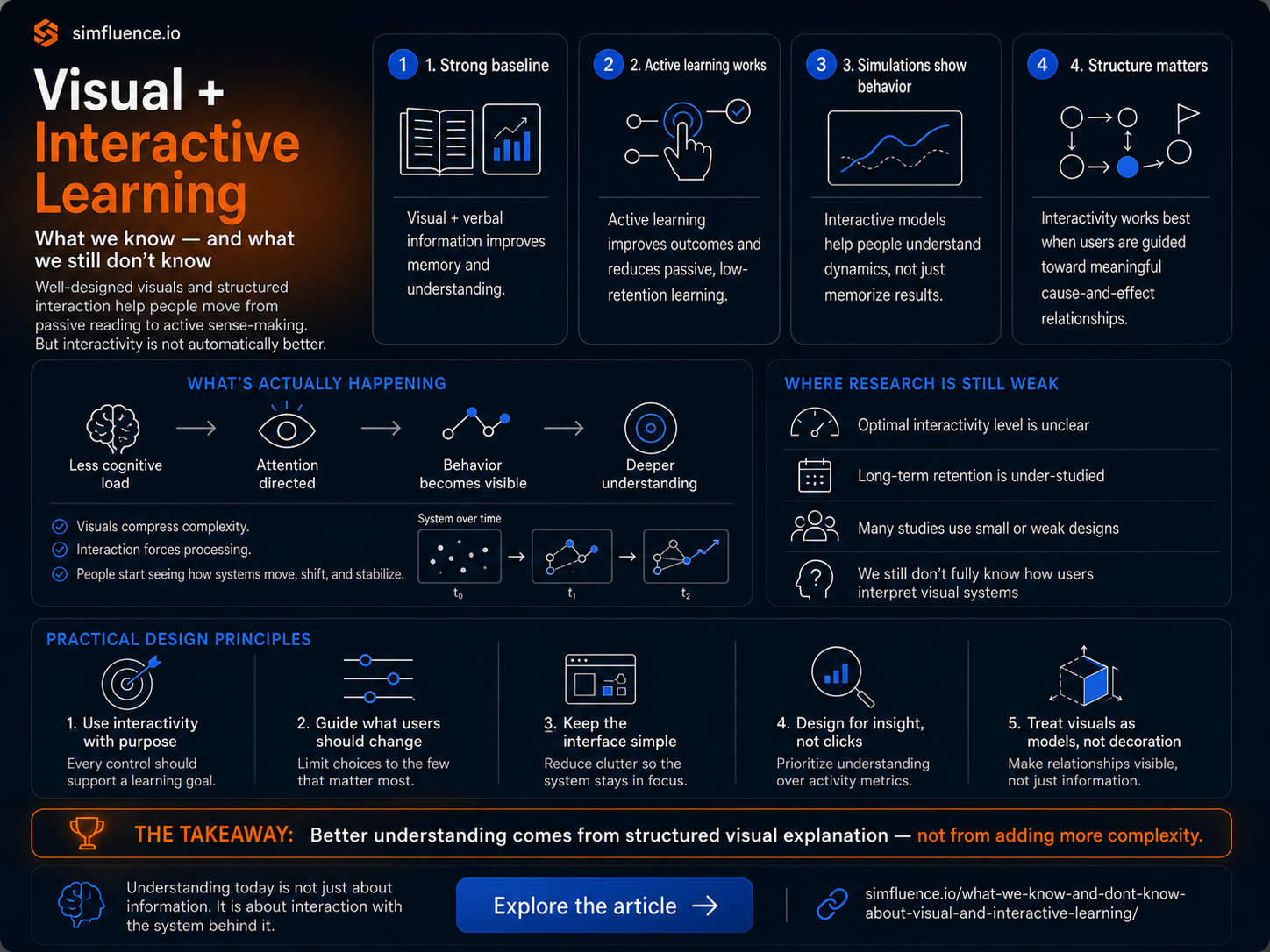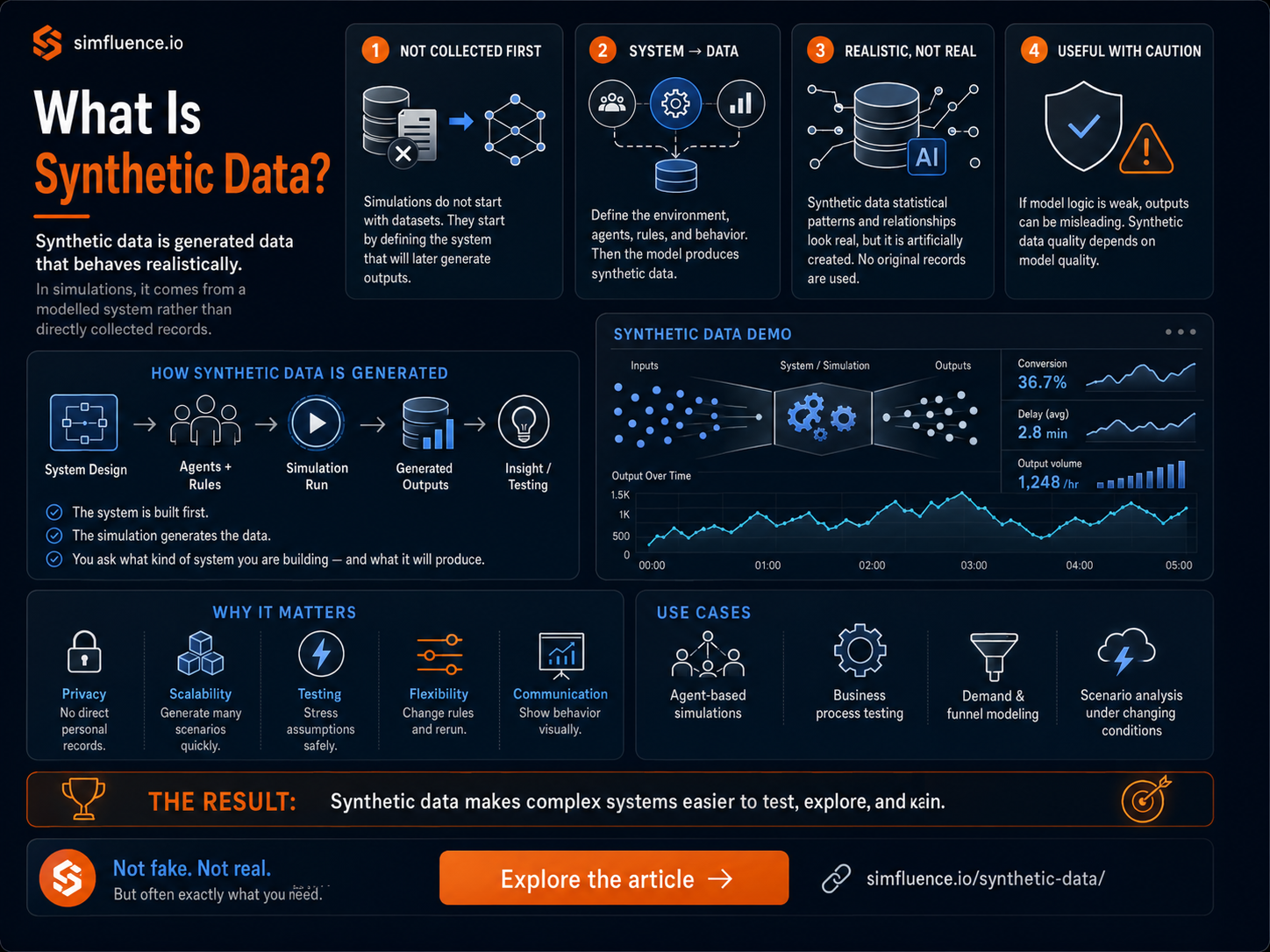
Most systems we care about aren’t simple.
Customers influence each other. Traffic builds up and clears unpredictably. Adoption doesn’t grow in a straight line—it spikes, stalls, sometimes collapses. When you try to explain these systems with averages or static charts, something important gets lost.
That’s where agent-based models (ABMs) come in.
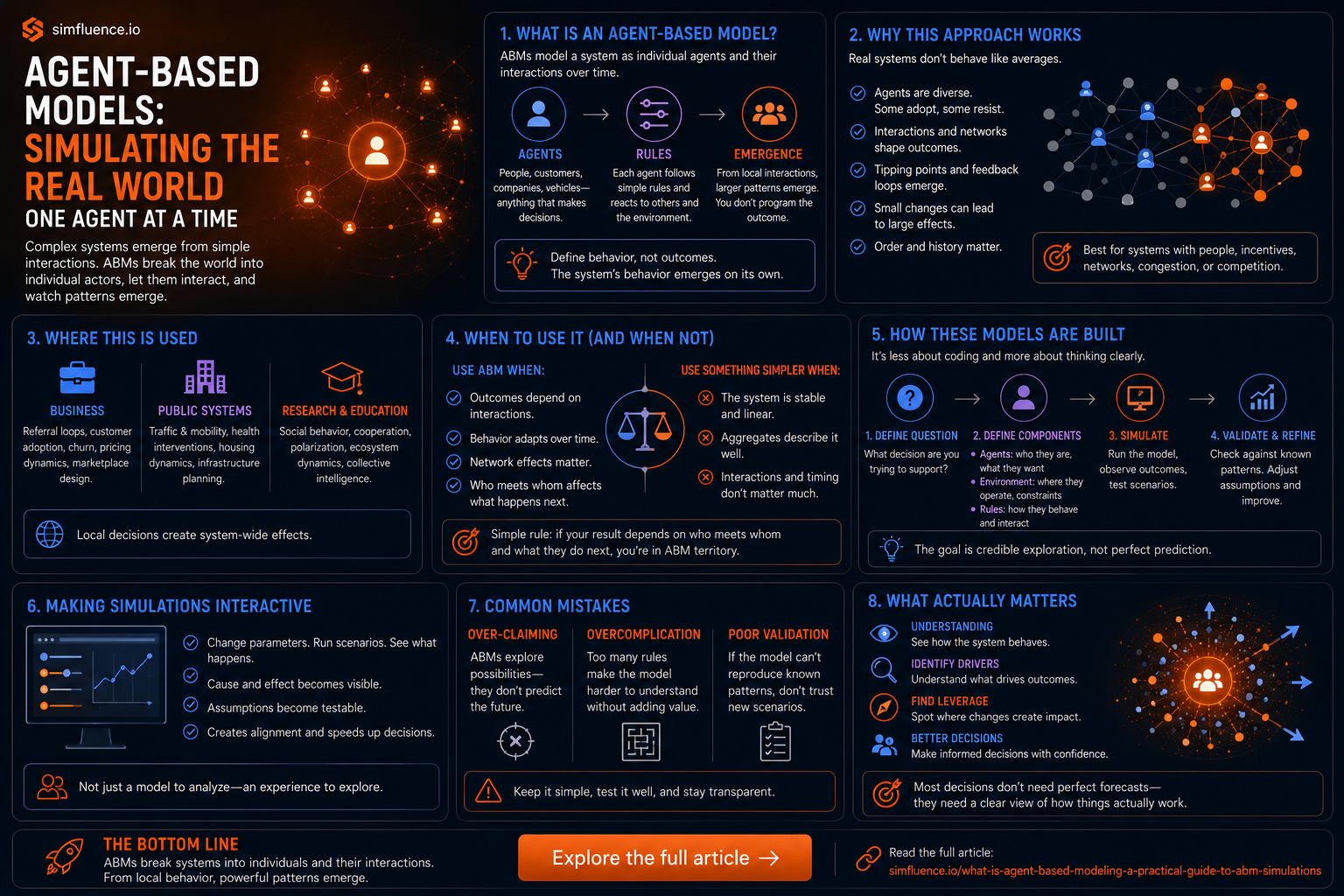
What an agent-based model actually is
Instead of treating a system as one big equation, an ABM breaks it down into individual actors—agents. These can be people, customers, companies, vehicles—anything that makes decisions.
Each agent follows simple rules, interacts with others, and reacts to its environment. And from those local interactions, larger patterns start to emerge.
That’s the key idea: you don’t program the outcome—you define behavior, and the outcome forms on its own.
Why this approach works
Traditional models ask: what happens on average? But real systems don’t behave like averages.
They depend on who interacts with whom, when, and under what conditions.
In an ABM, agents can be different. Some adopt quickly, others resist. Some influence others more strongly. Some are well-connected, others isolated.
When you let these agents interact, you start seeing things that are hard to capture otherwise—tipping points, feedback loops, cascading effects. Small changes can trigger large outcomes. The order of events matters. History matters.
This is why ABMs are especially useful in systems involving people, incentives, networks, congestion, or competition.
Where this is used in practice
In business, ABMs are used to explore referral loops, customer adoption, churn, and pricing dynamics. Instead of assuming one “average customer,” you simulate many different ones interacting.
In public systems, they’re used for traffic, mobility, health interventions, and housing dynamics, where local decisions create system-wide effects.
In research and education, they help explain social behavior, cooperation, polarization, and ecological systems—things that don’t reduce well to simple averages.
When to use it (and when not)
ABMs aren’t always the right tool.
If a system is stable, linear, and well-described with aggregates, simpler models are often enough.
But if outcomes depend on interactions, adaptation, and network effects, then you’re likely dealing with something that fits an agent-based approach.
A simple rule: if your result depends on who meets whom and what they do next, you’re in ABM territory.
How these models are actually built
Building an ABM is less about coding and more about thinking clearly.
You start with a question. What decision are you trying to support?
Then define:
- the agents (who they are, what they want)
- the environment (where they operate, what constraints exist)
- the rules (how they behave and interact)
From there, you test and adjust. You check whether the system behaves in a way that makes sense. Not perfectly accurate, but credible enough to explore.
Making simulations interactive
This is where things get much more powerful.
Instead of sending a report, you let people interact with the system. Change a parameter, run a scenario, see what happens.
Now it’s not just a model. It’s something you can explore.
This creates alignment fast. Instead of debating slides, people react to the same system. Cause and effect becomes visible. Assumptions become testable.
Especially in areas like growth, operations, and policy, this changes how decisions are made.
Common mistakes
There are a few typical pitfalls.
One is over-claiming. These models don’t predict the future—they explore possibilities.
Another is overcomplication. Too many rules make the system harder to understand without adding real value.
And then there’s validation. If your model can’t reproduce patterns you already know, you shouldn’t trust what it says about new scenarios.
What actually matters
The real value of agent-based modeling isn’t precision.
It’s understanding.
It helps you see how a system behaves, where it breaks, and what actually drives outcomes. It makes invisible dynamics visible.
And when you make it interactive, it becomes even more useful. Not just something you analyze—but something you can test, question, and explain.
In the end, most decisions don’t need perfect forecasts.
They need a clear view of how things actually work.