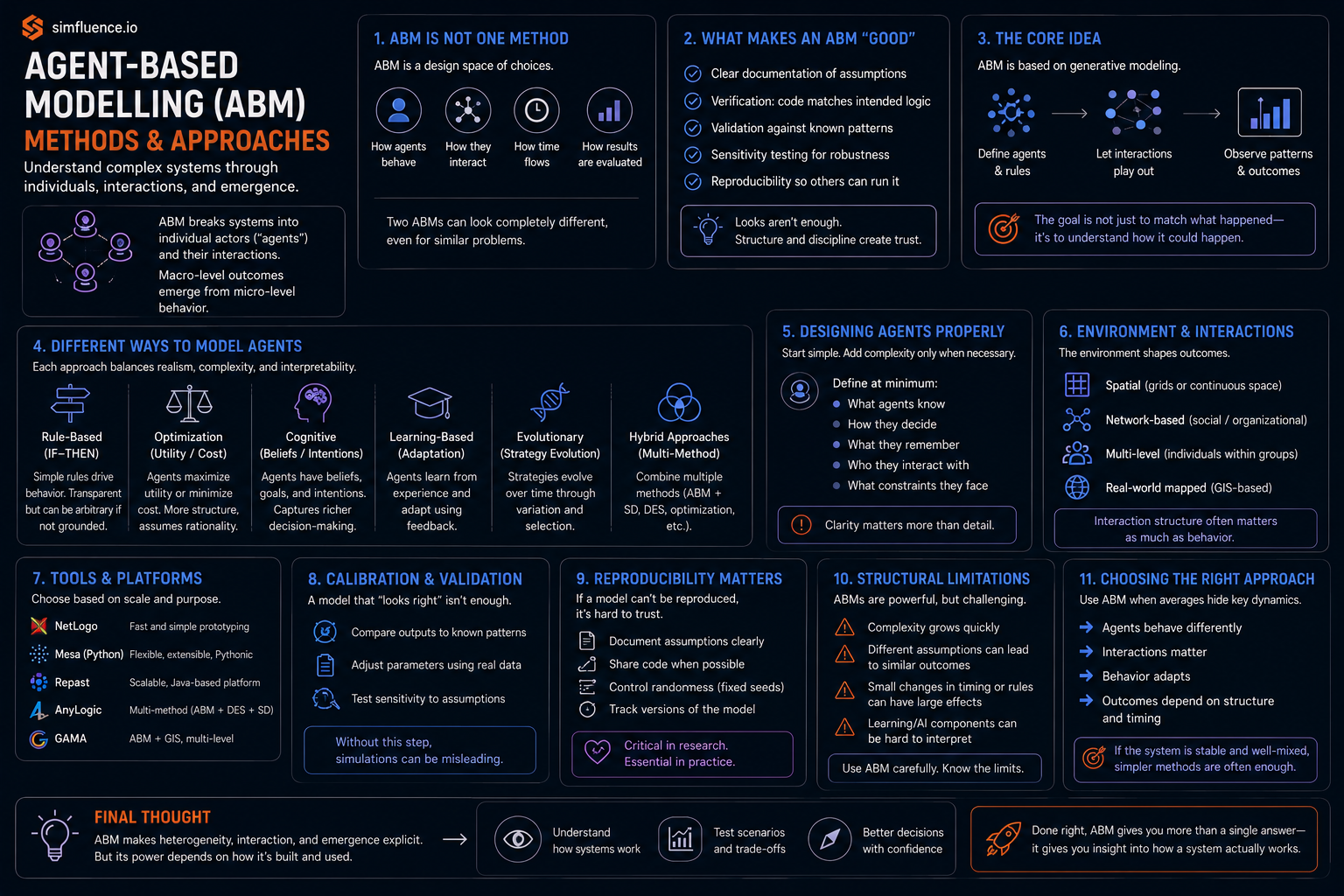
Agent-Based Modelling (ABM), often called agent-based simulation, is a way to understand complex systems by breaking them down into individual actors (“agents”) and their interactions.
Instead of describing a system through one big equation, ABM takes a different route. You define how individuals behave, let them interact, and observe what happens. From that, larger patterns emerge.
That’s the core idea: macro-level outcomes come from micro-level behavior.
ABM is not one method
ABM isn’t a single fixed technique. It’s more like a design space of choices.
When building a model, you’re deciding how agents behave, how they interact, how time flows, and how results are evaluated. Some models rely on simple rules, others on optimization, learning, or even hybrid approaches.
So two ABMs can look completely different, even if they’re studying similar problems.
What actually makes an ABM “good”
It’s easy to focus on visuals—moving dots, clean interfaces—but those don’t determine model quality.
What actually matters is structure and discipline. A solid model has:
- clear documentation of assumptions
- verification that the code matches the intended logic
- validation against known patterns
- sensitivity testing to check robustness
- reproducibility so others can run it
Without these, a model may look convincing but won’t be reliable.
The core idea behind ABM
ABM comes from a way of thinking often called generative modeling.
Instead of trying to directly fit outcomes, you build a system that could produce those outcomes. You define agents, give them rules, and let interactions play out.
The goal isn’t just to match what happened—it’s to understand how it could happen.
Different ways to model agents
There are several ways to design agent behavior.
The simplest is rule-based modeling, where agents follow IF–THEN logic. It’s transparent and easy to work with, but can become arbitrary if not grounded.
Another approach is optimization, where agents try to maximize utility or minimize cost. This adds structure but often assumes more rationality than exists in reality.
More complex models include cognitive approaches, where agents have beliefs and intentions, and learning-based models, where agents adapt over time using feedback.
There are also evolutionary models, where strategies evolve, and hybrid approaches that combine multiple simulation methods.
Each approach balances realism, complexity, and interpretability differently.
Designing agents properly
One of the biggest mistakes is making agents too complex.
Good ABMs start with the minimum necessary structure. You define only what’s needed to capture the behavior you care about.
As complexity increases, it becomes harder to understand what actually drives results.
At a basic level, you need to define:
- what agents know
- how they decide
- what they remember
- who they interact with
- what constraints they face
Clarity here matters more than detail.
Environment and interactions
Agents always operate within an environment, and that environment shapes outcomes.
This can be:
- spatial (grids or continuous space)
- network-based (social or organizational connections)
- multi-level (individuals within groups)
- real-world mapped systems (GIS-based)
In many cases, the structure of interactions matters as much as the behavior itself.
Tools and platforms
There are many tools available for building ABMs.
Some are lightweight and fast for prototyping, like NetLogo. Others are more flexible and scalable, like Mesa (Python) or Repast. Platforms like AnyLogic or GAMA allow combining ABM with other simulation approaches.
The right choice depends on the scale and purpose of the model.
Calibration and validation
A model that “looks right” isn’t enough.
You need to check whether it behaves in a way that aligns with reality. That usually means:
- comparing outputs to known patterns
- adjusting parameters using real data
- testing how sensitive results are to assumptions
Without this step, simulations can become misleading.
Reproducibility matters
If a model can’t be reproduced, it’s hard to trust.
That’s why it’s important to:
- document assumptions clearly
- share code when possible
- control randomness (e.g. fixed seeds)
- track versions of the model
This is especially critical in research, but it matters in practice too.
Structural limitations
ABMs are powerful, but they come with challenges.
They can become complex quickly. Different assumptions can lead to similar outcomes. Small changes in timing or rules can have large effects. And models that include learning or AI components can become harder to interpret.
These are not reasons to avoid ABM—but they are reasons to use it carefully.
Choosing the right approach
Not every problem needs an agent-based model.
If your system is stable and can be described with averages, simpler methods are often enough.
ABM becomes useful when:
- agents behave differently
- interactions matter
- behavior adapts
- outcomes depend on structure and timing
In other words, when averages hide what actually drives the system.
Final thought
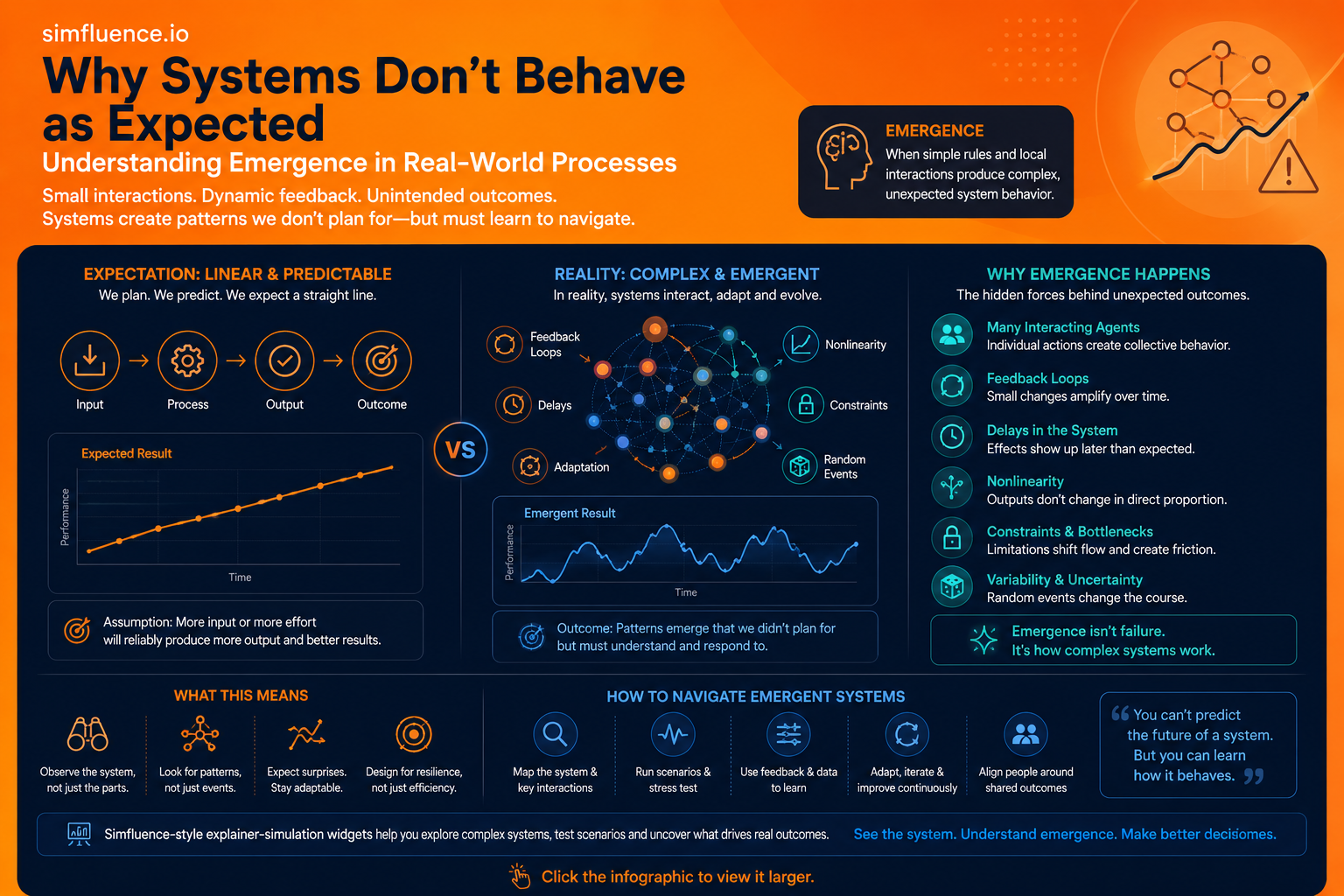
Agent-Based Modelling is powerful because it makes three things explicit: heterogeneity, interaction, and emergence.
But that power only matters if the model is built and used properly. It needs to be transparent, grounded, and tested.
Otherwise, it’s just a complex animation.
Done right, though, ABM gives you something much more valuable than a single answer.
It gives you a way to understand how a system actually works.