custom simulation solutions • tailored build

Custom Simulation Solutions

Built from scratch to match your system, your data, and your decision context. Not every system fits into a template. When the logic is complex, the stakes are higher, or the story needs to be exact, you need a custom-built simulation. Custom simulation solutions are designed specifically around your product, process, or strategy. They model the actual dynamics of your system, not a simplified version. The result is not just a visual - but a decision-grade explainer tailored to your use case.
Best when
The system is too specific for a template and the logic needs to hold under scrutiny.
Format
Fully tailored auto-run, interactive, or hybrid simulation built around your exact use case.
Works on
Web experiences, sales tools, internal workflows, workshops, policy analysis, and strategy support.
Output
Decision-grade simulation asset with tailored logic, outputs, and interface.
How the format works
Example: tailored operating model with calibrated baseline
tailored build calibrated logic browser-ready
system
variables
baseline
decisions
Real structure, realistic assumptions, and tailored outputs make the simulation useful for explanation, comparison, and decision support.
system fit
exact
Variables, flows, and constraints are defined from your use case, not a generic structure.
baseline
validated
The behavior can be aligned with data, realistic assumptions, or calibrated scenarios.
delivery
flexible
Custom builds can be auto-run, interactive, or hybrid depending on the decision context.
What makes it different
Built around your system. No generic structure - variables, flows, and outputs are defined from your actual use case.
Matches real-world behavior. It can be aligned with data, realistic assumptions, and calibrated baseline scenarios.
Flexible format. Custom solutions can be auto-run explainers, interactive simulations, or hybrids.
Decision-grade credibility. The logic is built to support trust, scrutiny, and meaningful comparison.
Synthetic data generation. The simulation can generate realistic scenario-based, stress-test, or edge-case datasets when real data is limited, sensitive, or incomplete.
Exportable data. Outputs can be exported as CSV, time-series results, or scenario comparison datasets for analytics, reporting, and downstream workflows.
Still lightweight Even custom simulations remain browser-based, embeddable, and shareable without heavy infrastructure.
Built for reuse Use the same asset across web, sales, internal workflows, workshops, and strategy discussions.

What a custom simulation actually is

A custom simulation is a fully tailored interactive or auto-run model built around your real process, your variables and constraints, and the outputs or narrative you actually need.

It combines system logic, agent behavior, scenario control, and a clear visual interface into one usable solution. You do not adapt your story to the simulation - the simulation is built around your story.
  • Model real flows, dependencies, constraints, and feedback loops.
  • Represent users, units, actors, or agents when behavior matters.
  • Add scenario controls, policies, inputs, and decisions where needed.
  • Package everything into a clear usable interface for explanation or decision support.

When to use custom solutions

Choose custom when the system is too specific for a template, multiple layers or interactions need to be modeled, credibility and accuracy matter, stakeholders need to trust the logic, or you want to simulate your exact reality instead of a generic version.

This is the right product when the structure is unique, the stakes are higher, and the logic has to hold under scrutiny.
  • The system is too specific for a template.
  • Multiple layers or interactions need to be modeled.
  • Credibility, realism, and trust in the logic matter.
  • You need to simulate your exact operating reality, not an illustrative version.

Explain complex systems clearly

Show how things actually work, not just what the outcome is, even when the structure has multiple moving parts.

Test scenarios before committing

Compare strategies, policies, or configurations in a controlled environment before making the real-world move.

Support decisions

Turn assumptions into something visible and testable so decisions are backed by modeled behavior instead of opinion alone.

Align stakeholders

Give everyone the same model to reason about so teams can discuss trade-offs on shared ground.

Generate and test data

Produce realistic datasets and compare outcomes across scenarios, even when real data is missing, incomplete, or too sensitive to use directly.

Data layer: beyond visualization

Custom simulations are not only visual models - they can function as data engines. Instead of relying only on historical data, the model can generate realistic synthetic datasets based on modeled behavior and system logic.
  • Generate scenario-based datasets from simulated user activity, flows, demand, or system behavior.
  • Create stress-test conditions and rare edge-case situations that may not exist in current datasets.
  • Scale realistic patterns into larger synthetic environments for testing and analysis.
  • Use the model when real data is limited, sensitive, incomplete, or not yet available.

Export results for analysis

Simulation outputs are not only visual. They can be exported as structured data, which lets the simulation act as both an explainer tool and a data-generating system for downstream analysis.
  • Download CSV datasets, time-series outputs, and scenario comparison results.
  • Feed generated outputs into BI tools, analytics workflows, reporting pipelines, or supporting models.
  • Support AI or ML training data, safer scenario testing, and stakeholder analysis without real-world risk.
  • Validate assumptions against generated outcomes before decisions move into the live system.

Use cases

Product and solution modeling Explain how your product impacts outcomes under different conditions.
Operations and system optimization Simulate workflows, bottlenecks, capacity, and throughput across the operation.
Revenue and growth systems Model funnels, adoption, pricing effects, or scaling dynamics.
Risk and resilience Show how issues propagate and how mitigation changes outcomes.
Public sector and policy Simulate interventions, resource allocation, or system-wide effects.
Strategy and configuration testing Compare strategies, policies, or operating configurations before committing.
Stakeholder alignment Give teams and decision-makers the same model to reason about instead of competing assumptions.
Synthetic data and AI support Generate training, testing, or scenario data for AI models and analytics workflows.

System structure

Customize stages, flows, dependencies, network structure, spatial layouts, and agent interactions.

Variables and controls

Tune demand, capacity, budget, policy, behavior rules, and external factors to match the real decision context.

Outputs

Define visual simulation outputs, scenario comparisons, performance metrics, and exportable datasets such as CSV, time-series results, and scenario runs.

Visual layer

Tailor terminology, interface layout, branding, and presentation so the simulation feels native to your context.
Why custom instead of template

Templates are great when the structure is known and the goal is fast clarity. Custom is the right move when the system is unique, the stakes are higher, and the logic must hold under scrutiny. Even then, the delivery can still stay browser-based, easy to embed, shareable via link, and usable across contexts.
tailored build specific system decision-grade fully adaptable browser-based easy to embed shareable by link usable across contexts

How it typically works

Custom simulation work usually moves from goal definition, to system mapping, to agent-based model building, baseline validation, interface design, and refinement into a ready-to-use asset.
1. Define the goal What should the simulation explain, test, or prove?
2. Map the system Identify the key components, variables, flows, and interactions.
3. Build the model Translate the logic into a working simulation.
4. Validate the baseline Ensure the behavior reflects a realistic scenario.
5. Add interaction or narrative Define controls, outputs, user experience, and presentation logic.
6. Deliver and refine Prepare it for web, sales, workshops, or internal use and refine as needed.
Some systems are too important to simplify. Custom simulations give you a way to show how things actually behave, test decisions before making them, and communicate complexity without losing clarity.

Not just a simulation - a controlled system that generates data, tests decisions, and makes behavior visible.

Auto-run - show the story. Interactive - explore the system. Custom - model your reality.

Explore custom simulation examples

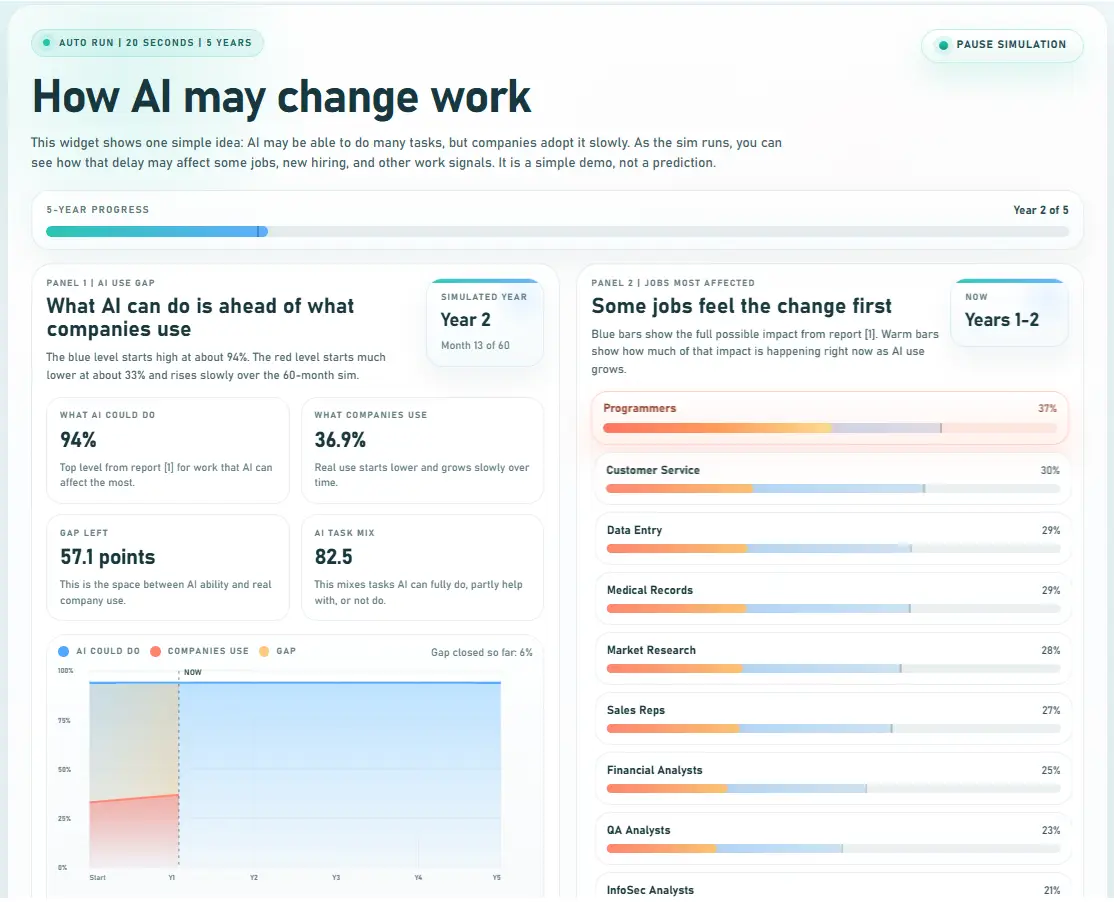
How AI may change work This widget shows one simple idea: AI may be able to do many tasks, but companies adopt it slowly. As the sim runs, you can see how that delay may affect some jobs, new hiring, and other work signals. It is a simple demo, not a prediction.

How AI may change work

This widget shows one simple idea: AI may be able to do many tasks, but companies adopt it slowly. As the sim runs, you can see how that delay may affect some jobs, new hiring, and other work signals. It is a simple demo, not a prediction.

Read more