defects • traceability • recall scope
Product Recall: Traceability vs No Traceability Simulation
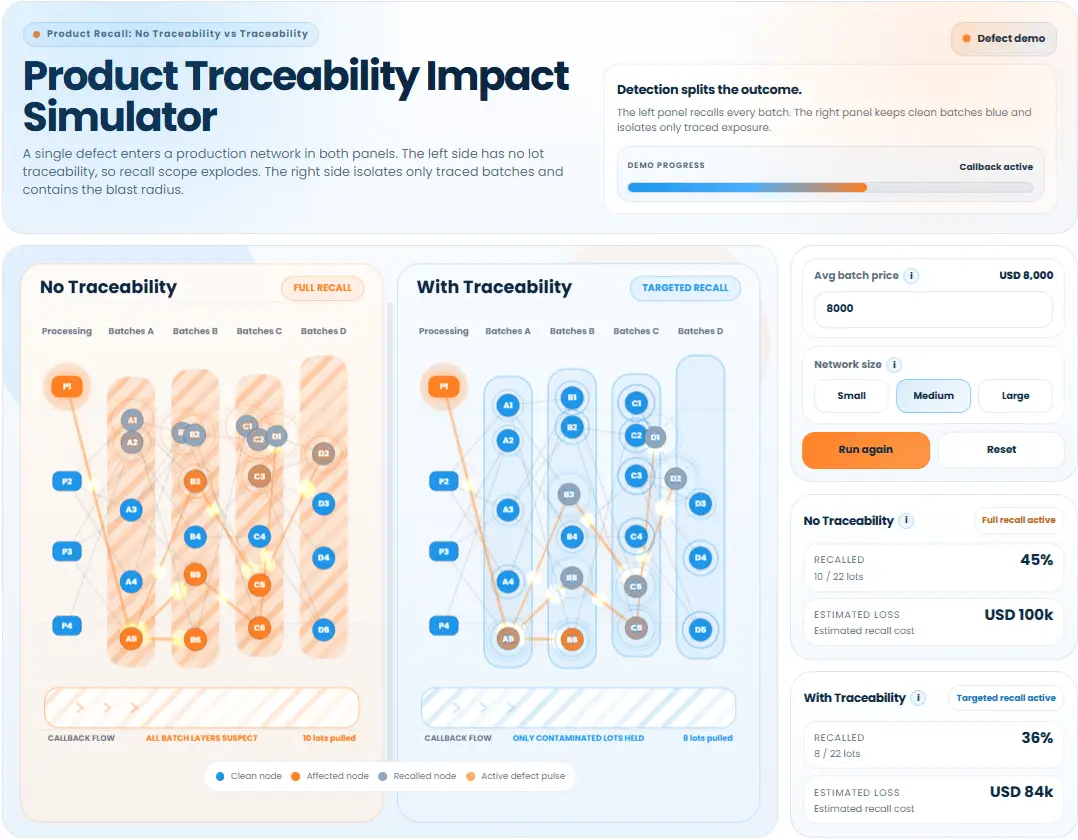
A single defect enters the same production network in both panels. The left side has no lot traceability, so recall scope explodes.
The right side isolates only traced batches and contains the blast radius.
step 1 — defect demo
step 2 — recall outcome
clean node
affected node
recalled node
active defect pulse
what it shows
How one defect can propagate through a shared production graph before detection.
Why missing traceability makes the recall scope explode (you must assume too much is affected).
How lot-level tracing isolates batches, shrinking recall size and loss.
core controls
avg batch price:USD slider (e.g., 8,000)
network size:small / medium / large
run again:replay the same scenario
reset:defaults
live outputs
recalled:% and lots recalled (e.g., 0% • 0 / 22 lots)
estimated loss:USD (after recall actions)
potential loss:USD before recall (worst-case exposure)
state:incident spreading → recall triggered
best for
traceability & quality pages (show “blast radius”)
compliance sales (why lot-level matters)
ops workshops (stress-test detection timing)
exec decks (loss delta in seconds)
traceability
product recall
defect propagation
blast radius
lot tracking
quality
risk
loss
network
containment
Both panels start identical. Then a defect appears (e.g., process P3), spreads through the network, and the recall decision hits.
With traceability, you recall only what’s linked. Without it, you recall everything plausible.
- Custom Simulation
- Defect Propagation in Supply Chains
- Failure Impact Simulation
- Financial Loss Simulation
- Interactive Simulation and Explainer Tool
- Network Systems Simulation
- Product Lot Tracking
- Product Recall Management
- Product Traceability Simulation
- Quality Management Systems
- Risk Analysis
- Risk Containment Simulation