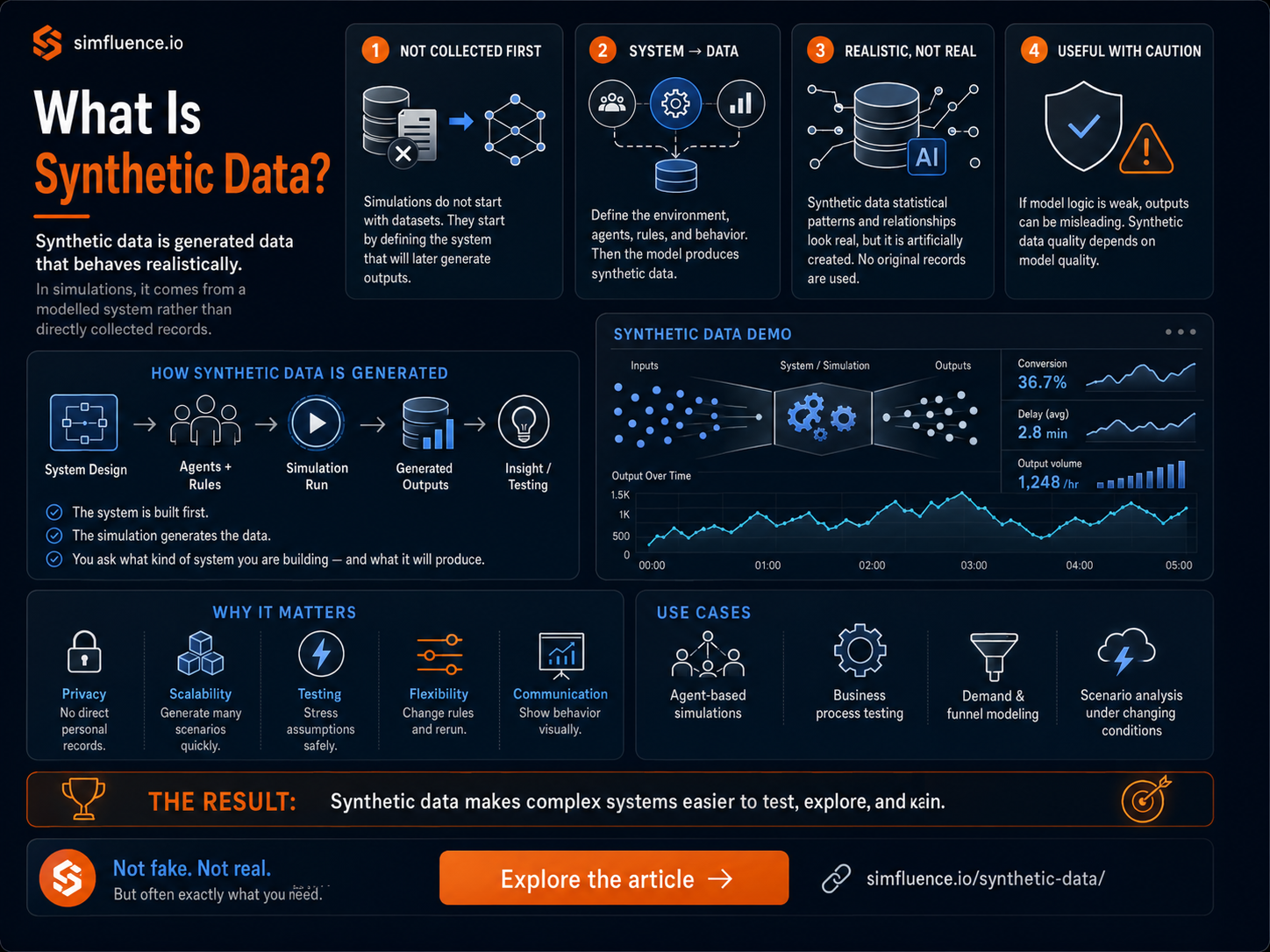
Synthetic data is generated data that feels and behaves realistically.
When people hear the word data, they usually think of something that has been collected and already exists.
For example, if we see logs, reports, and dashboards, we assume it is something that is reported and analyzed.
But in simulations, that’s not usually the case.
Simulations do not start with data; the starting point is defining the system that will later generate the data.
What is synthetic data?
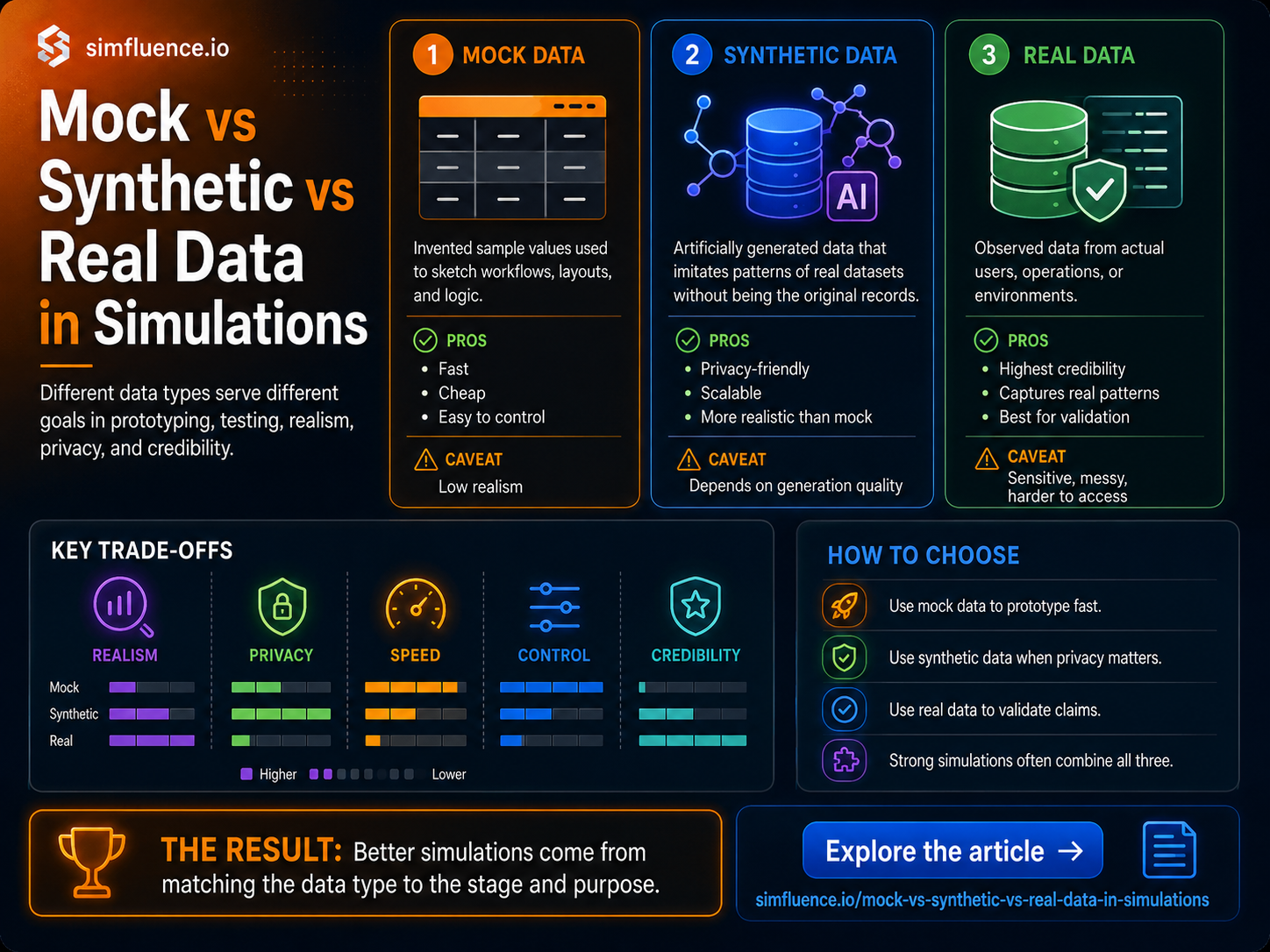
Synthetic data is generated data that is created by systems imitating real-world data. Synthetic data does not violate privacy. It works similarly to real-life data, using the patterns and properties, but is generalized or altered to actual gathered data.
Synthetic data behaves like real data—but it isn’t real. And that’s exactly why it’s useful.
Synthetic Data Generation
To generate Synthetic Data, the system will be defined first. In Simulations, the environment, the agents, the rules, and the behaviour are all defined and mapped out. Then the system starts producing outputs that are defined as synthetic data.
This means that instead of asking What data are we using?, the better question would be What kind of system are we building, and what kind of data will it generate?
That is the shift that most people miss.
Synthetic data is just fake data. It is data that behaves like something real because it is created from a model that captures how a process actually works. If the logic is reasonable, the output feels and looks real. Even though nothing was collected or measured.
Synthetic Data examples
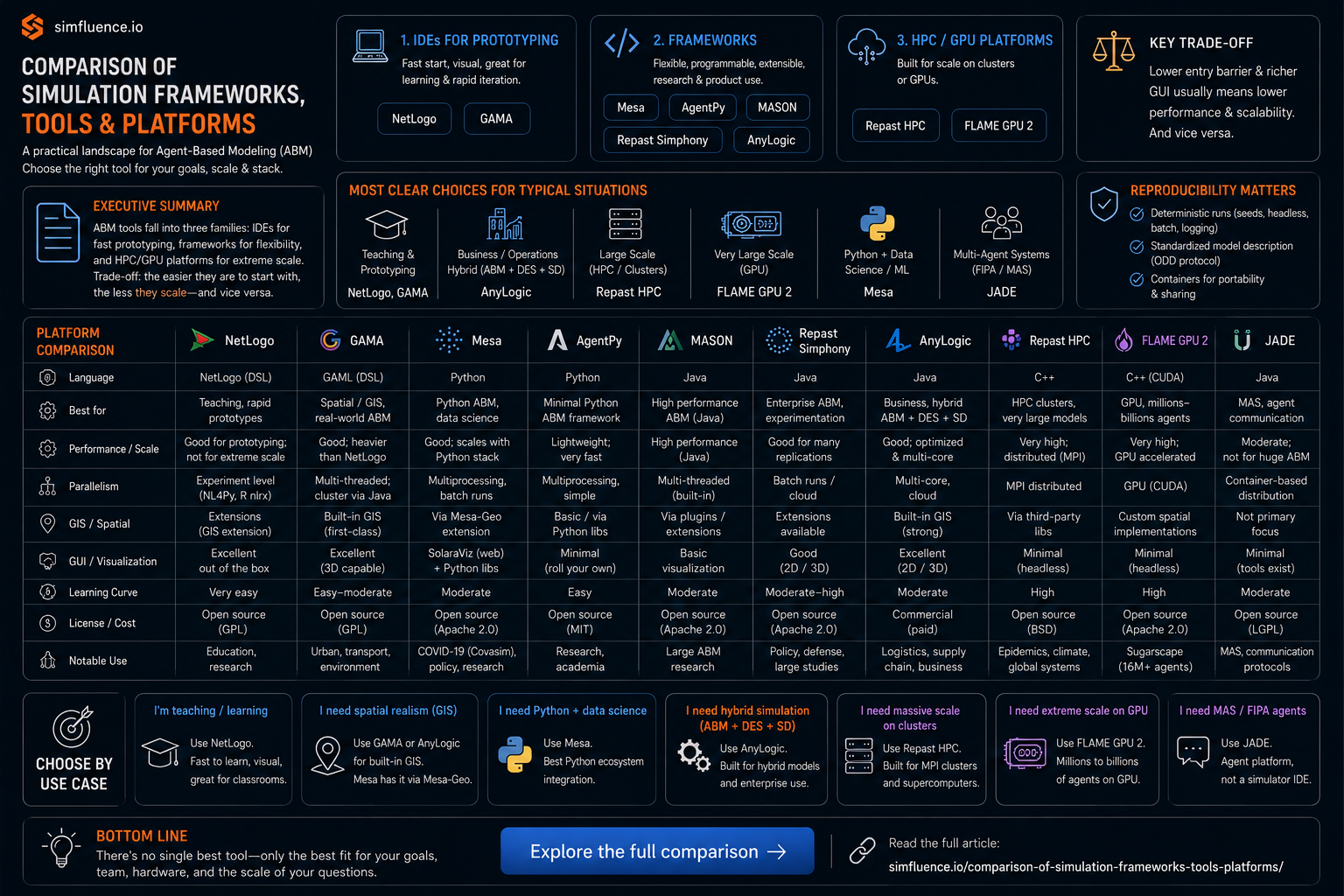
At Simfluence, we have created many simulation examples that all produce synthetic data. You open a model and see users moving through a funnel, items flowing through a system, or demand building up over time. It feels real because the patterns make sense. But what you’re actually looking at is a system generating outcomes based on rules.
Not replaying reality—creating it.
It is basically a real-data-like machine. The conversion rates, delays, interactions, and constraints are defined, and the system produces data as if that world existed.
This is very different from using real data. Learn the difference between test data types from our synthetic data vs real data article.
Real data tells you what happened. It is backward-looking. You can analyze it, maybe forecast a bit. However, testing new scenarios means changing something in the real system, which is slow, expensive, or risky.
Simulation data shows you what could happen. You just change the rules and run it again. With that kind of synthetic data generation, you can test endless combinations.
What happens if your conversion rate improves by 5%?
What if demand doubles?
What if a small delay appears early in the process?
Instead of guessing, you simulate it. The system generates new data under those conditions, and you see the outcome immediately. You don’t speculate—you see the outcome.
If you want to see examples outside the business world, you could check the article on how a 3D dog is created from a single photograph. This kind of data usage is widely spread and used in more and more fields of life.
Synthetic data generation use cases
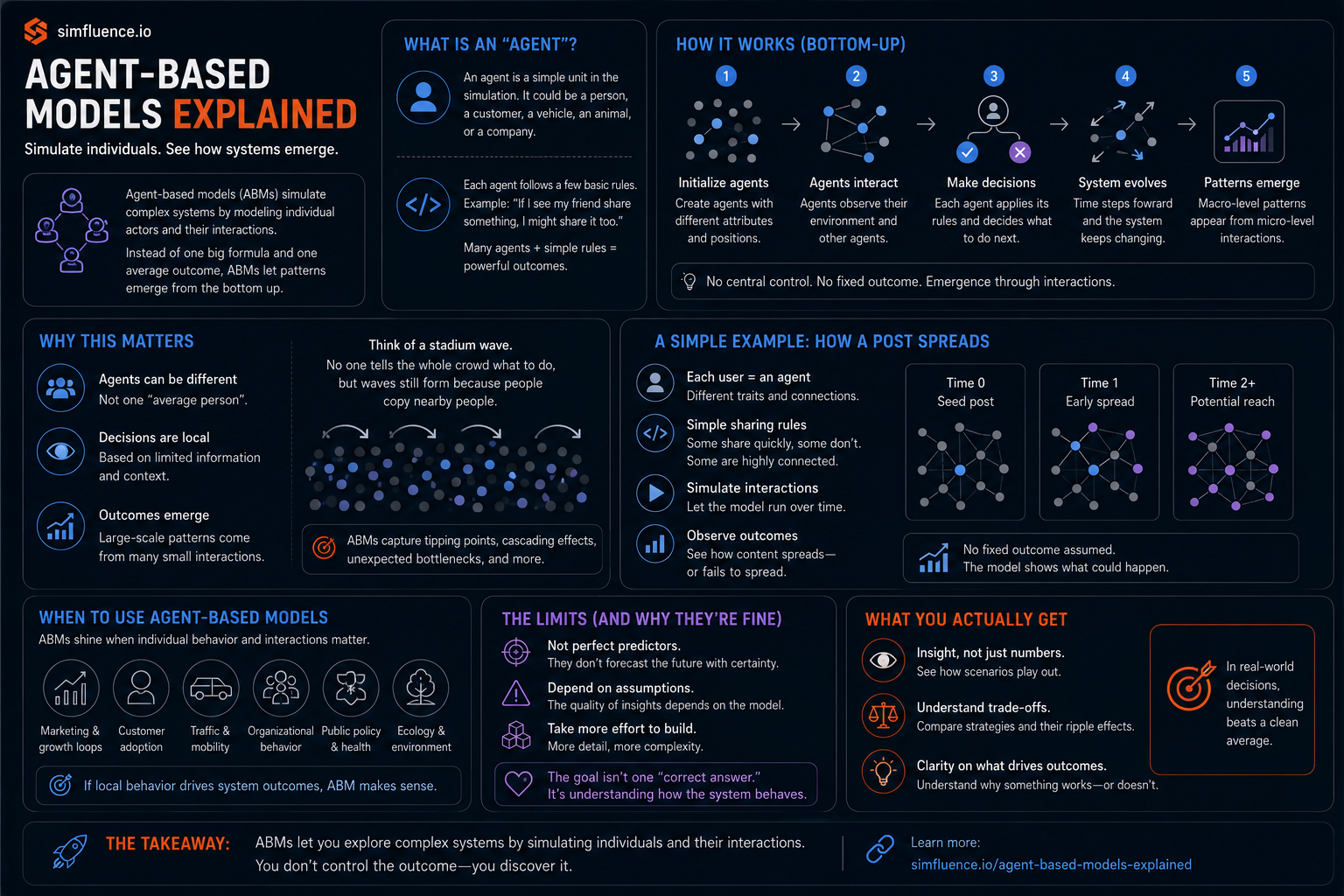
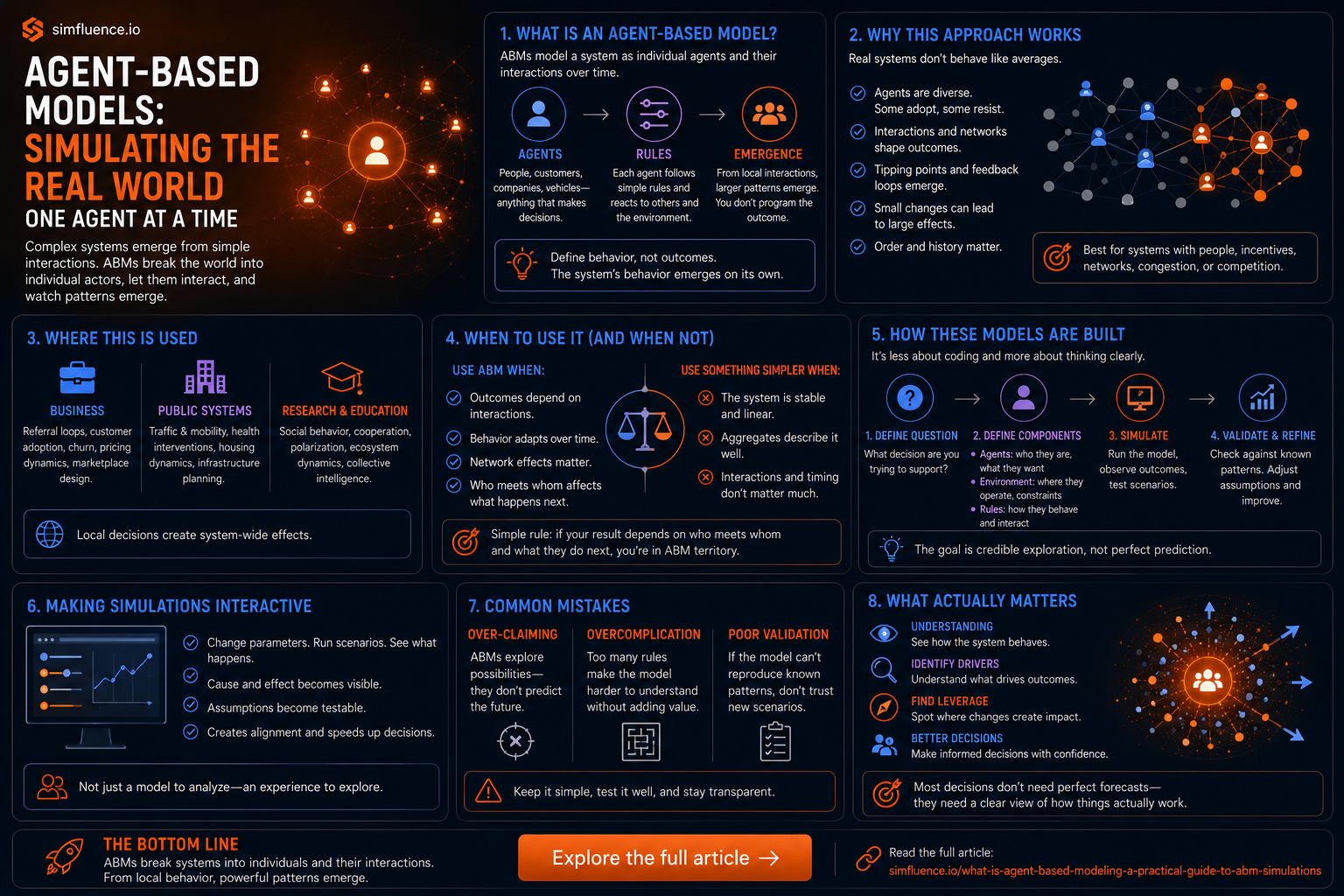
One very common Synthetic data generation use case is agent-based modeling. Instead of working with aggregated numbers, you simulate individual actors—customers, users, teams—each following simple rules. When they interact, the system produces realistic patterns: growth, drop-offs, and feedback loops.
The data you see is not imported.
It’s emerging.
That’s what makes it powerful—and also what requires a bit of caution.
Because synthetic data can look very convincing. Clean visuals, smooth flows—it all feels right. But if the underlying assumptions are wrong, the output is still wrong. It just looks good.
So the quality of synthetic data is always tied to the quality of the model.
The goal of simulation data isn’t to perfectly replicate reality. It’s to make systems understandable and testable. To have a safe environment where the variable could be played and tested.
In many cases, that’s more useful than raw real data.
Real data could be messy, incomplete, and often restricted. It shows one version of reality—the one that already happened.
Synthetic data, on the other hand, lets you explore many possible realities quickly.
You can scale it.
You can stress it.
You can reshape it.
And most importantly, you can visually communicate with the synthetic data.
A well-designed simulation using synthetic data can explain a complex system in 20 seconds. Not by showing numbers, but by showing behavior. People don’t need to interpret a chart—they see what’s going on.
That’s the real value.
So when we say simulations are “data-driven,” it doesn’t always mean they’re driven by stored data. More often, they’re driven by systems that generate data.
Not fake.
Not real.
But useful in a way that many real datasets cannot be.
And in many business contexts, that’s exactly what you need.