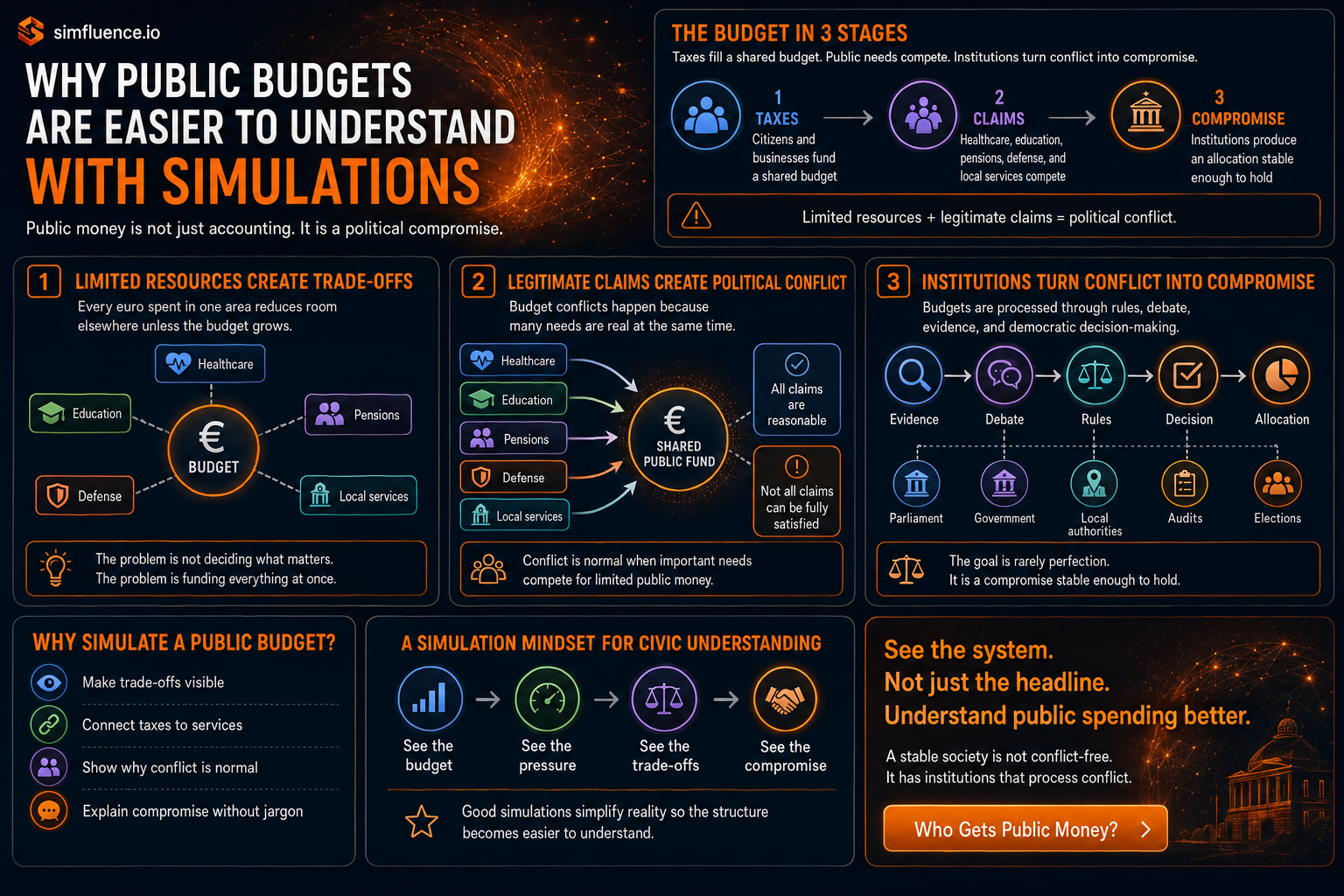
Public budgets are often discussed as if they were only technical documents. Numbers go in, numbers go out, and the final result appears as a table of ministries, programmes, and spending lines. But this way of presenting public money hides the most important part of the process. A government budget is not just an accounting exercise. It is a political compromise.
Every society has more needs than it has available money. Healthcare needs more doctors, better access, shorter queues, and stronger prevention. Education needs teachers, schools, digital tools, and long-term investment in skills. Pensions need to support older people and maintain intergenerational trust. Defense needs funding for security, readiness, and resilience. Local services need roads, waste management, transport, libraries, parks, and everyday maintenance.
All of these claims can be legitimate at the same time. That is what makes budgeting difficult.
This is why we built the Civic Budget Explainer: Who Gets Public Money?
The simulation is designed as a short visual explainer. It does not try to model a real national budget, predict actual government spending, or calculate the correct allocation between policy areas. Instead, it helps users understand the basic structure of public budgeting: taxes create a limited common resource, different groups and services make claims on that resource, and institutions must turn conflict into a compromise stable enough to hold.
The core message is simple: a stable society is not conflict-free. It has institutions that process conflict.
This matters because public debate often treats political conflict as a sign that something has gone wrong. People argue. Interest groups pressure decision-makers. Parties disagree. Public servants negotiate constraints. Citizens feel that their own issue is underfunded. Media headlines focus on winners, losers, and scandals. From the outside, this can look like dysfunction.
But conflict itself is not the problem. In a democratic society, conflict is unavoidable because people have different needs, values, risks, and time horizons. The real problem begins when institutions can no longer process that conflict into a workable compromise.
A public budget makes this visible. If more money goes to one area, less money is available somewhere else unless taxes, debt, or economic growth change the size of the budget. More healthcare spending may be necessary, but it still competes with education, defense, pensions, infrastructure, and local services. More defense spending may be justified by security risks, but it still creates pressure elsewhere. Higher pensions may protect older citizens, but they also raise questions about the tax base and future obligations.
That is the trade-off structure the simulation is meant to show.
A written article can explain that public money is limited. It can also say that politics involves compromise. But those statements often remain abstract. People understand the words without seeing the mechanism. A simulation makes the mechanism visible. Users see tax money flow into one shared budget. They see public needs pull on that budget from different directions. They see that every group can have a reasonable claim, but not every claim can be fully satisfied.
This is where Simfluence-style simulations are useful. They do not replace detailed analysis. They simplify reality so that the structure becomes easier to understand. A good simulation does not pretend that public budgeting is simple. It shows why it is complex.
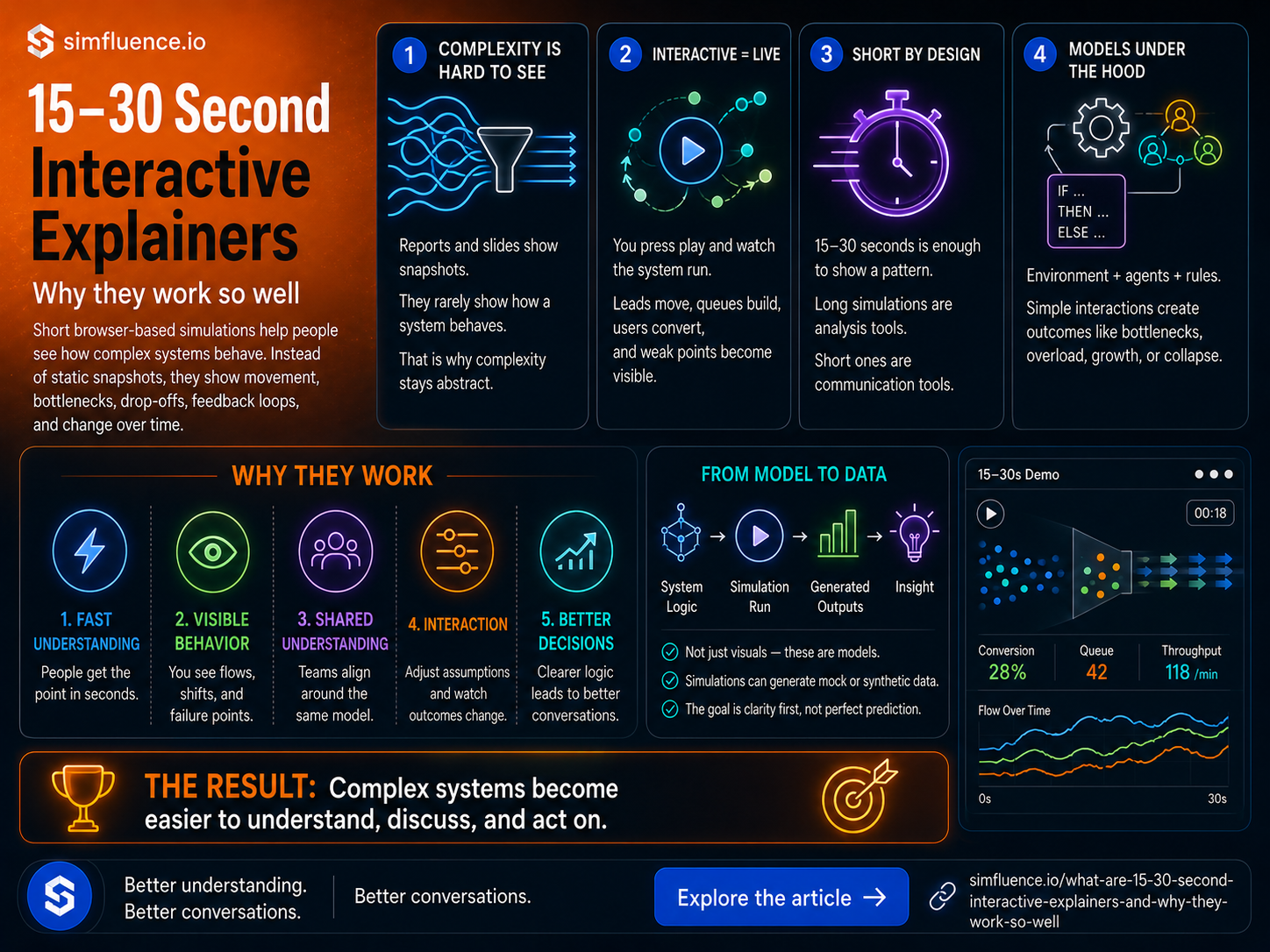
The Civic Budget Explainer works as a 20-second visual story. There are no sliders, tables, or dashboard-style controls. The goal is not to make users optimise a budget. The goal is to communicate one civic lesson clearly: politics is partly the process of turning competing claims into a compromise.
That point is especially important for civic education. Many people encounter public budgets only through fragments: a news headline about tax increases, a campaign promise, a debate about hospital funding, a local road repair issue, or a pension dispute. Each issue can feel separate. But they are connected through the same limited budget. The simulation helps show that connection.
It also helps explain why “just fund everything important” is not a serious budget strategy. Healthcare is important. Education is important. Pensions are important. Defense is important. Local services are important. The difficulty is not deciding whether these areas matter. The difficulty is deciding how much each receives when the full list of legitimate needs exceeds available resources.
This is also why interest groups matter. In a healthy political system, groups articulate needs that might otherwise be ignored. Teachers argue for schools. Doctors argue for healthcare. Pensioners argue for security. Local communities argue for roads, transport, and services. Security experts argue for defense. These claims create pressure, but pressure is not automatically bad. It can make hidden needs visible.
The risk is that the loudest groups, best-organised groups, or most politically useful groups dominate the process. That is why institutions matter. Budget rules, parliamentary debate, public consultation, expert analysis, local government input, audits, and elections all help shape how conflict becomes a decision. These institutions do not remove disagreement. They make disagreement manageable.
The simulation’s final message is therefore not anti-politics. It is the opposite. It shows that politics is necessary because society is complex. Public money must be allocated under constraint. People will disagree because the stakes are real. The task is not to remove conflict, but to handle it without breaking the system.
This makes the explainer useful for educators, public-sector teams, civic organisations, journalists, policy communicators, and anyone trying to explain government budgeting in a clearer way. It can support discussions about taxation, welfare, public services, defense spending, local government, democratic compromise, and the role of institutions.
It is also useful because it avoids a common mistake: presenting the budget as if there were one obvious correct answer. In reality, budget decisions depend on values, priorities, evidence, political mandates, demographic pressure, security risks, economic conditions, and institutional rules. A simulation can make this visible without overwhelming the user with technical detail.
The Civic Budget Explainer is therefore best understood as a thinking tool. It simplifies public finance, but it does so openly. It does not include every real-world factor: debt, inflation, tax design, EU rules, procurement, demographic modelling, coalition politics, lobbying power, administrative capacity, or long-term economic forecasts. Those details matter. But before people can understand those details, they need to understand the basic structure.
Taxes create a shared resource.
Public needs make claims on that resource.
Limited resources plus legitimate claims create political conflict.
Institutions turn that conflict into a compromise stable enough to hold.
That is the civic logic the simulation is built to explain.
Try the Civic Budget Explainer here:
Who Gets Public Money? Civic Budget Explainer
Watch how public money becomes a shared budget, how competing claims create pressure, and how compromise becomes the central work of democratic institutions.