Return on investment is one of the most common business terms, but it is also one of the easiest to misuse. People often talk about ROI as if it were a single fixed number: this project has a good ROI, this investment pays back quickly, this automation saves money. But in practice, ROI depends on assumptions. It depends on costs, time, adoption, avoided work, productivity gains, implementation risk, and how long the benefit is expected to last.
That is why ROI is often difficult to communicate. A spreadsheet may contain the logic, but it usually hides the story. A presentation may show the final number, but it often skips the assumptions behind it. A business case may argue that a project is worth doing, but decision-makers still need to understand what actually drives the result.
This is where an interactive ROI calculator becomes useful.
The Simfluence ROI Calculator is designed to make business value easier to explore, not just easier to claim.
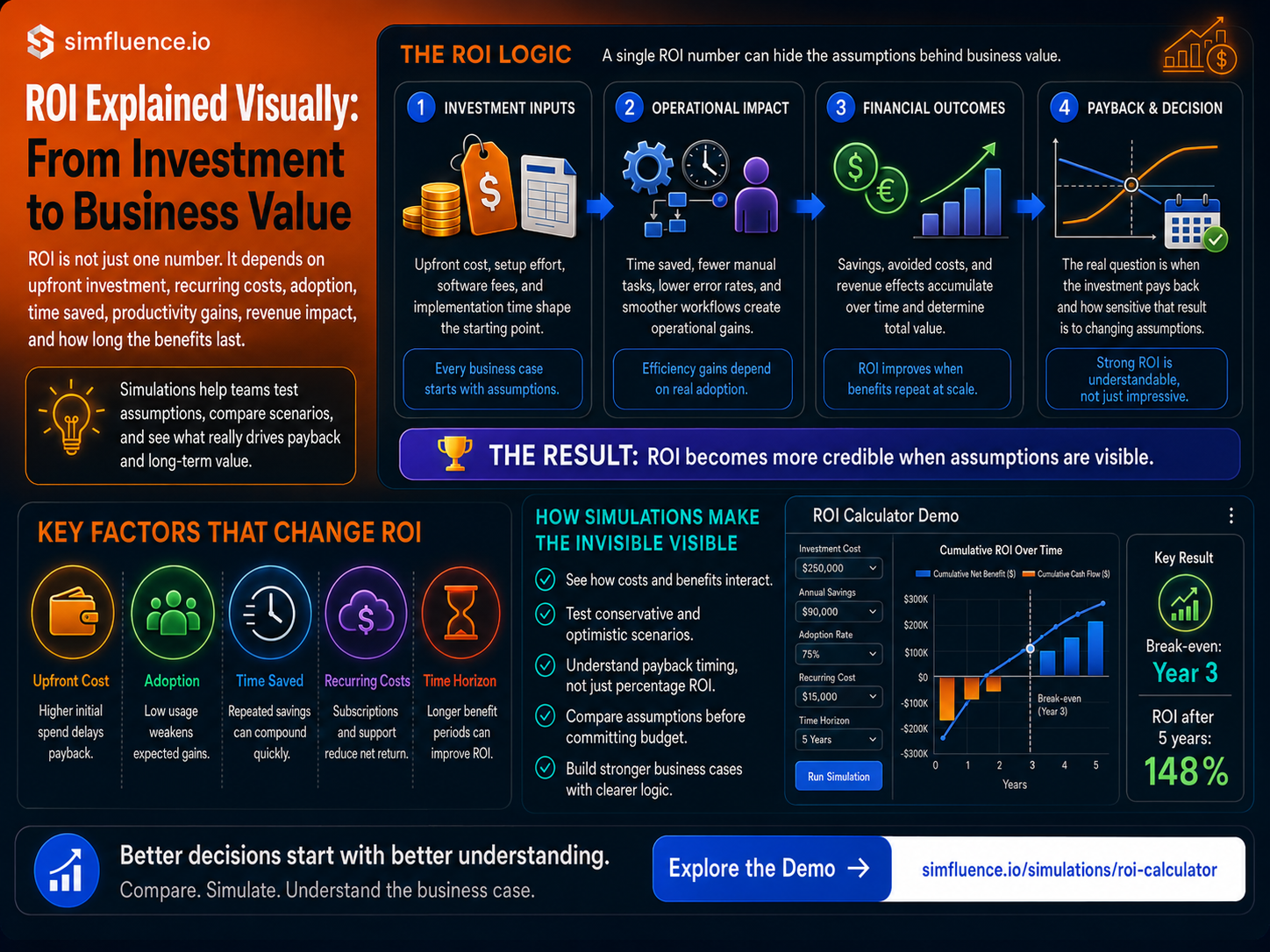
The point of the calculator is simple: instead of presenting ROI as one static answer, it lets users test the relationship between investment, cost savings, productivity gains, payback time, and long-term value. That makes the business case more transparent. It also makes weak assumptions easier to spot.
A useful ROI discussion should not start with the final percentage. It should start with the structure of the calculation. What is the initial investment? What are the recurring costs? What savings are expected? Are those savings based on time saved, fewer manual tasks, lower error rates, faster delivery, or increased revenue? How long does it take before the investment pays for itself? What happens if the expected gains are lower than planned?
These are exactly the questions that a good simulation can make visible.
A static ROI estimate often gives the impression of certainty. It may say that a project will return 180%, pay back in six months, or save a certain amount per year. But that number can become misleading if users do not see how sensitive it is. A small change in adoption rate, labour cost, implementation time, or recurring platform cost can significantly change the outcome.
An interactive calculator makes this sensitivity easier to understand. Users can adjust the inputs and immediately see how the result changes. That shift matters. The user is no longer just reading a business claim. They are testing the logic behind the claim.
This is especially useful for automation, AI tools, digital transformation projects, and software investments. These projects often promise efficiency, but the value is rarely created by technology alone. Value comes from the relationship between the tool, the process, the people using it, and the organisational changes around it. A tool that saves time in theory may produce limited ROI if adoption is low. A tool with a high upfront cost may still make sense if it reduces repetitive work at scale. A small automation may create strong ROI if it removes a frequent bottleneck.
That is why ROI should be treated as a scenario, not as a slogan.
The calculator helps users compare scenarios by changing the assumptions directly. A conservative scenario may show slower payback and lower return. A stronger scenario may show how value compounds when savings repeat over time. A riskier scenario may reveal that the business case depends too heavily on one optimistic assumption. This is useful because it moves the discussion away from vague confidence and toward visible trade-offs.
A good ROI calculator should also separate different kinds of value. Some benefits are direct and financial, such as lower labour cost, lower operating cost, or avoided external spending. Other benefits are indirect, such as faster response times, better quality, fewer errors, improved customer experience, or more capacity for higher-value work. Not all of these are easy to convert into money, but they still matter. The important thing is to show clearly which benefits are included in the calculation and which remain outside it.
This also helps prevent a common mistake: using ROI as a decorative number after the decision has already been made. In that case, the calculation becomes a justification tool. A better use of ROI is diagnostic. It should help teams understand whether the investment logic is strong, fragile, or dependent on assumptions that still need validation.
The Simfluence ROI Calculator works best as a thinking tool. It does not remove uncertainty. It makes uncertainty easier to work with. Users can see how costs and benefits accumulate over time, where the break-even point appears, and which assumptions have the biggest influence on the result.
This makes it useful for teams preparing business cases, explaining automation value, comparing investment scenarios, or communicating digital transformation projects to non-technical audiences. It can also support sales conversations, internal planning, workshops, and public-facing explainers where the goal is not only to persuade, but to help people understand.
The real value of a calculator like this is not that it gives one final answer. The real value is that it reveals the mechanism behind the answer.
If the result changes dramatically when one input changes, that is important. If the payback period depends on unrealistic adoption, that is important. If most of the value comes from one cost-saving assumption, that is important. A good simulation helps users see these weak points before they become expensive mistakes.
Try the Simfluence ROI Calculator here:
https://simfluence.io/simulations/roi-calculator/
Adjust the assumptions and watch how the result changes. The strongest business case is not the one with the biggest ROI number. It is the one where the logic remains understandable, testable, and realistic.