LLM visual explainer • training • inference • next-token prediction
How an LLM Learns and Builds Replies
Two compact views of the same model.
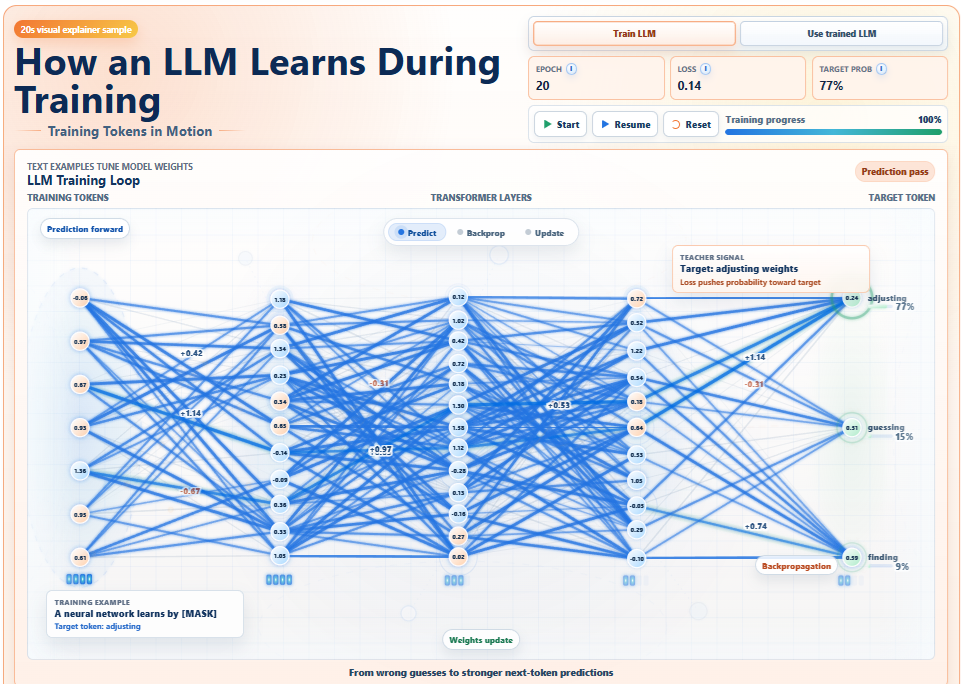
In training, text examples update model weights through prediction, loss, backpropagation, and small weight changes.
In use, the trained weights stay fixed while the model turns a prompt into a reply one token at a time.
compare training vs. use
token activation
model weight
backprop / attention signal
token probability / confidence
Epochi
17
Lossi
0.15
Target probi
76%
how training works
prediction pass:training tokens move forward through transformer layers.
target token:the correct next token shows which prediction should become more likely.
loss:measures the gap between the model’s guess and the correct next token.
how generation works
tokenize:prompt words become tokens that enter the transformer.
attend:temporary attention scores connect prompt tokens across layers.
generate:one next token is chosen, appended, and the loop repeats.
main distinction
training:weights change slowly across many examples.
use:weights stay fixed; only temporary activations and attention scores change.
shared structure:tokens pass through transformer layers and produce probability scores.
training example
text:A neural network learns by ...
correct next token:adjusting
training signal:increase probability of “adjusting”
prompt example
user prompt:Explain neural networks simply
assistant draft:A neural network learns by ...
loop:next token chosen again and again
visual sequence
01Predict — model guesses the next token
02Measure loss — compare guess with correct token
03Backprop — gradients flow backward through layers
04Update weights — useful paths strengthen, weak paths fade
01Tokenize — words become prompt tokens
02Attend — prompt tokens influence each other across layers
03Predict token — candidates compete by probability
04Reply grows — selected token is appended to the answer
legend notes
token activation:a circle showing how a training token is represented inside the model.
model weight:a learned connection strength that changes slowly during training.
epoch/loss/prob:epochs count passes; loss should fall; target-token probability should rise.
fixed weights:learned parameters stay fixed while one reply is generated.
attention score:a temporary prompt-specific signal, not a weight update.
uncertainty/confidence:candidate tokens compete; stronger probability increases confidence.
LLM training
transformer layers
training tokens
model weights
backpropagation
next-token prediction
attention scores
inference
loss
target probability
This explainer makes one technical distinction visible fast:
during training, the model itself is being changed. Text examples push probability toward correct next tokens, and repeated updates reshape model weights.
This explainer makes the other side visible:
during one reply, the trained weights do not update. The prompt creates temporary activations and attention scores while the answer grows token by token.