Yard & dock stability
DockFlow Systems — Yard & Dock Stability Simulation
Logistics yards can look stable when volume is normal. However, peak arrivals change the system fast:
check-in slows down, queues grow, and the yard locks up. This yard dock stability simulation makes that failure visible in under 20 seconds.
It also works as a yard congestion simulation, because it shows how small delays build into long waits.
Moreover, it acts as a dock scheduling simulation by comparing manual slotting with orchestration under the same demand.
Then you can switch DockFlow ON. As a result, the model becomes a dock door utilization simulation and a
detention and SLA risk simulation, because you can see how slot booking, predictive allocation, and real-time reassignment reduce late trucks.
In short, this yard dock stability simulation turns “avoid congestion” into something buyers and operators can see.
What this simulation demonstrates
What it shows
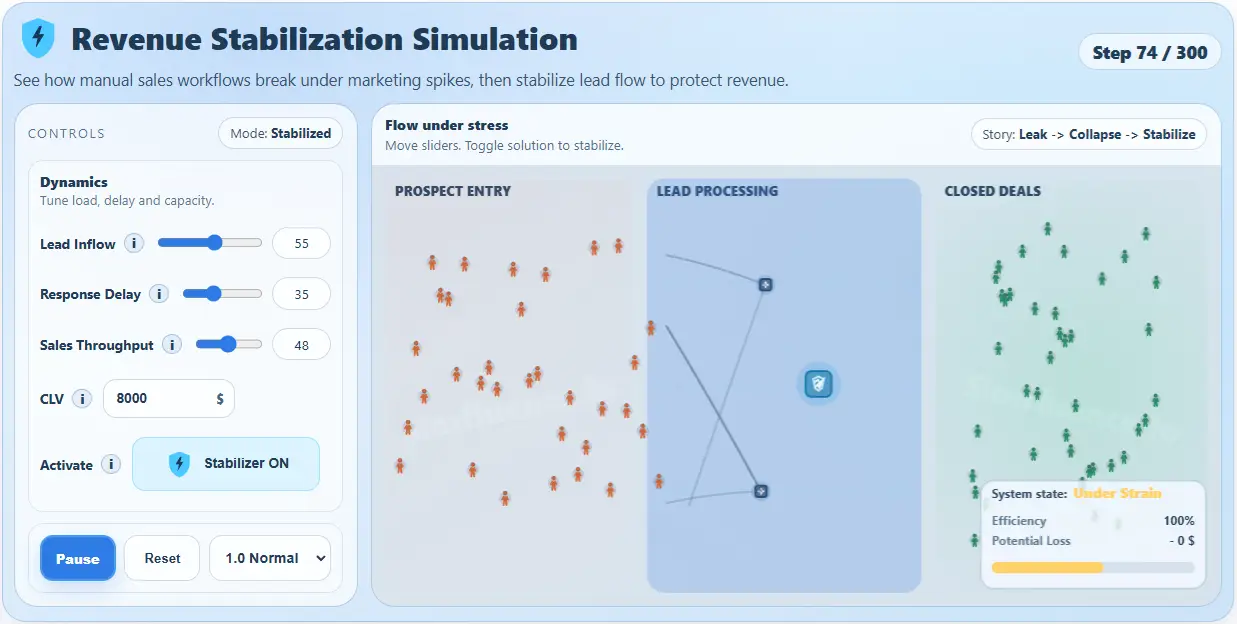
When arrivals surge, check-in friction compounds; therefore, queues grow and the yard can lock up.
Limited doors and crews turn variability into idle trucks; as a result, detention and SLA risk rise.
DockFlow stabilizes flow by slotting and reallocating doors, which keeps unloading balanced under load.
Core controls
Volume: Truck arrivals (peak load pressure)
Friction: Manual check-in (paper logs, mis-slotting, comms gaps)
Capacity: Dock capacity (doors + crews + unload efficiency)
Solution toggle: DockFlow ON/OFF (slot booking + allocation + reassignment)
Outputs
On-time throughput: Trucks processed within SLA / total arrivals (live %)
Potential loss ($): Delay penalties + idle truck costs + overtime impact
Yard stability: Congestion zone vs recovery zone under peak arrivals
Best for
3PL and DC sales pages, because it shows congestion prevention fast
Operations reviews (peak planning, staffing, door utilization)
Executive ROI discussions (detention + overtime in dollars)
SLA risk workshops (what breaks first under disruption)
How to use it
First, run DockFlow OFF to see the congestion path. Then raise volume and friction. Next, toggle DockFlow ON to compare recovery. Finally, use the outputs to explain what delays cost and where capacity breaks.
yard dock stability simulation
yard congestion simulation
dock scheduling simulation
dock door utilization simulation
detention and SLA risk simulation
slot booking
predictive allocation
real-time reassignment
SLA compliance
overtime labor
Toggle DockFlow ON vs OFF, raise truck arrivals, and watch how manual check-in turns peaks into yard lock-up.
Therefore, this works both as a buyer-facing explainer and as a planning tool for doors and labor.
Keywords: yard dock stability simulation, yard congestion simulation, dock scheduling simulation, dock door utilization simulation, detention and SLA risk simulation