OpsSync AI: Factory Flow Simulation for Bottlenecks and Throughput Stability
This interactive factory flow simulation demonstrates how production systems react to failures, queue buildup, and uneven task arrivals. Many factories rely on static schedules; however, variability quickly creates bottlenecks and downtime across the line.
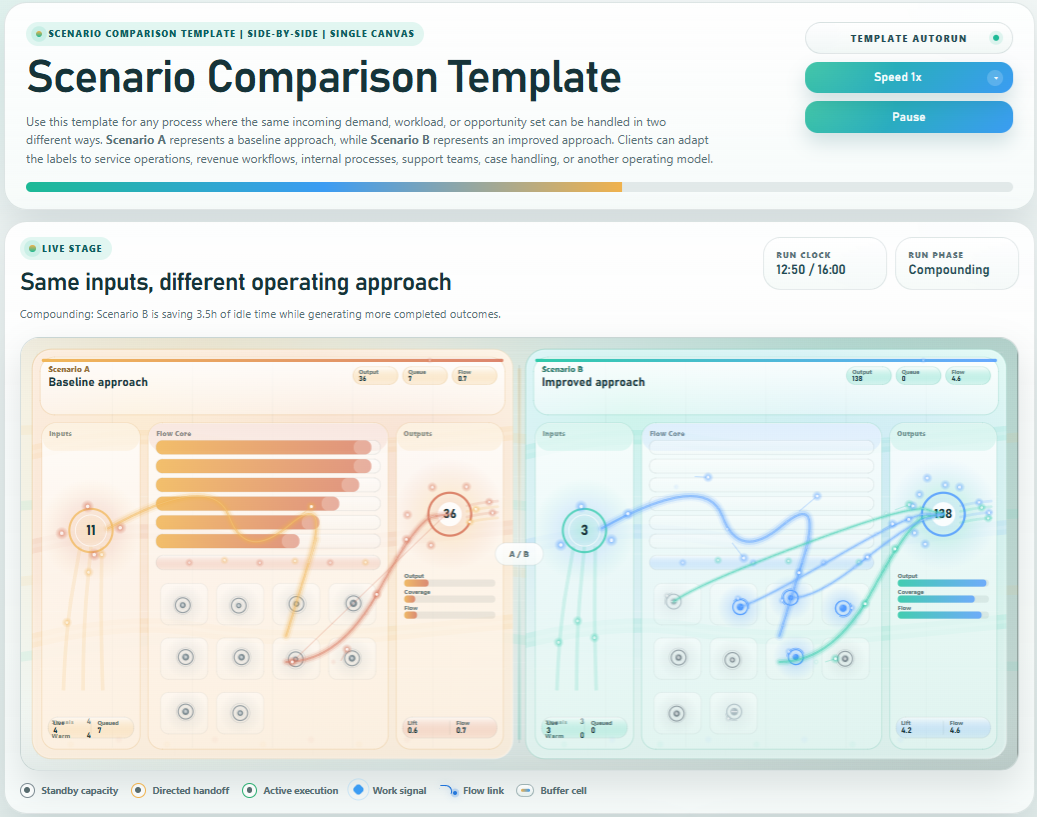
The model works as both a manufacturing bottleneck simulation and a manufacturing process flow simulation. It visualizes how tasks move through machines, how congestion spreads, and how throughput changes when coordination improves.
In the second phase, the simulation activates AI coordination. This demonstrates AI production scheduling optimization and shows how dynamic task reallocation stabilizes capacity across the system. As a result, the model also functions as a factory throughput optimization simulation, allowing viewers to see throughput improvements in real time.
Why coordination matters in factory systems
In many factories, scheduling is fixed in advance. At first this approach appears efficient. Nevertheless, real production rarely behaves as expected. Machines fail, tasks arrive unevenly, and queues begin to grow.
Over time, these small disruptions compound. Consequently, a single failure may trigger multiple bottlenecks across the line. This factory flow simulation demonstrates exactly how those chain reactions form.
What the simulation shows
Where this factory flow simulation helps
Industrial AI vendors often struggle to explain the value of coordination software. Slides and dashboards rarely show the real system behavior. Therefore, many buyers underestimate the impact of operational variability.
An interactive factory flow simulation solves that communication gap. Instead of describing improvement, the model visually demonstrates how stability emerges when coordination logic changes.
- AI Job Impact Simulation
- Interactive Simulation and Explainer Tool
- Predictive Load Balancing
- Process Bottleneck Simulation
- Queue Dynamics Simulation
- real-time coordination
- Resource Utilization Simulation
- Static vs Dynamic Scheduling Simulation
- System Downtime Simulation
- System Failures and Variability
- Throughput Stability Simulation